
Industry News
Curation by industry experts
Hot Articles
Popular Tags
Hydrogen Certification Compliance Checks Before Commissioning New Systems
Hydrogen Certification Compliance Checks Before Commissioning New Systems
A hydrogen system is not ready for commissioning simply because installation is complete, pressure tests have passed, and equipment vendors have delivered their manuals. The more difficult question is whether the assembled system—vessels, pipework, valves, electrical panels, detection equipment, ventilation, controls, and operating procedures—works as a compliant safety envelope under actual operating conditions.
That is the purpose of a hydrogen certification compliance check. It is not a single document review and it is not limited to confirming a CE mark, an ISO reference, or a supplier declaration. Before introducing hydrogen, quality and safety teams need to verify that the design basis remains intact after procurement, construction, modifications, and site integration. This becomes especially important where hydrogen interfaces with gas turbines, reciprocating engines, fuel-cell systems, refuelling assets, standby power installations, or industrial process equipment.
The practical risk is usually found at the interfaces. A certified storage package may be installed in a poorly ventilated enclosure. A compliant detector may be mounted in the wrong location. A pressure-rated valve may be suitable for the stated design pressure but not for hydrogen service, cycling duty, or the site’s emergency isolation philosophy. These are not minor punch-list items. They can delay startup, trigger rework after an authority inspection, or leave operators with a system that is technically functional but not defensible in an audit.
Compliance starts with the correct regulatory map
There is no universal “hydrogen certificate” that makes every system acceptable everywhere. The applicable framework depends on geography, system purpose, pressure range, hydrogen state, installation environment, and the authority having jurisdiction. A containerised electrolyser, a hydrogen blending skid feeding an industrial burner, and a marine dual-fuel installation may all involve hydrogen, but their approval routes are materially different.
The first pre-commissioning task should therefore be a requirements register. It should identify the codes, standards, permits, client specifications, insurer conditions, and local fire-safety rules that apply to the completed installation. In the United States, projects may need to consider requirements adopted from NFPA 2 and other local codes. In Europe, pressure equipment may fall within the Pressure Equipment Directive, while equipment used in potentially explosive atmospheres may require assessment under the ATEX framework. Other jurisdictions may use different national laws while referencing ISO or IEC standards as technical guidance.
For technical benchmarking, relevant references can include ISO 22734 for water electrolysers, ISO 19880-1 for gaseous hydrogen fuelling stations, IEC 60079 for explosive atmospheres, ISO 14687 for hydrogen fuel quality, and ASME B31.12 for hydrogen piping and pipelines. None should be applied by title alone. Teams must confirm the current edition, local adoption status, exclusions, and whether the system truly falls within the standard’s scope. A standard can guide design without replacing a statutory approval requirement.
A useful discipline is to assign every requirement to evidence: a drawing, calculation, nameplate, factory acceptance record, inspection report, test certificate, procedure, or witnessed functional test. If a requirement cannot be tied to evidence, it is still an open item regardless of how complete the project appears.
Verify the installed asset, not just the vendor package
Hydrogen service makes material and assembly control more consequential than it may be in conventional natural-gas installations. Hydrogen can permeate through small leak paths and, in certain materials and conditions, contribute to embrittlement concerns. The compliance review should confirm that the actual pressure boundary matches the approved design documentation: pipe materials, fittings, weld procedures, flanges, seals, tubing, regulators, relief devices, and isolation valves.
Traceability deserves close attention. Material certificates, weld records, non-destructive examination results, pressure-test records, and relief-valve certificates often sit in separate contractor files. During handover, missing links between these records are common. A pressure vessel may have a valid certificate, for example, while the field-installed interconnecting piping has incomplete records for supports, welds, or final pressure testing.
Pressure protection is another area where paperwork can look reassuring while the installed system is not. Confirm the set pressure, discharge path, isolation arrangements, vent termination, drainage or condensation considerations, and whether a relief device can be inadvertently blocked in service. The question is not merely whether a pressure-relief device exists. It is whether it protects the final, as-built configuration in every credible operating mode, including maintenance isolation and abnormal shutdown.
For facilities using compressors, high-pressure storage, or cascade systems, review the duty cycle and pressure-transient assumptions behind the design. A component rated for pressure is not automatically suitable for repeated hydrogen cycling. Where equipment is supplied as a packaged unit, confirm that site tie-ins have not invalidated the supplier’s original boundary conditions.
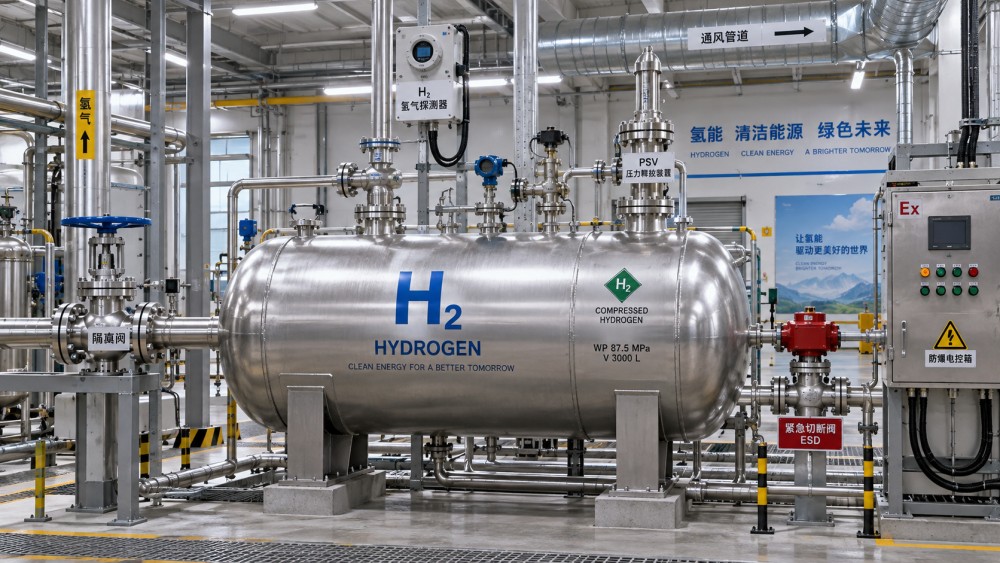
Leak detection, ventilation, and hazardous-area controls must work together
Hydrogen’s low ignition energy, wide flammability range, and tendency to rise rapidly mean that gas detection cannot be assessed in isolation. Detector selection, location, alarm logic, ventilation performance, electrical classification, and shutdown actions must form a coherent design.
A recurring field issue is reliance on a detector layout drawing without validating the final physical environment. Cable trays, roof geometry, ductwork, process skids, weather screens, and later design changes can alter gas accumulation paths. In an enclosed or partially enclosed space, the detector location should be reviewed against the actual ventilation pattern and potential release points, not simply installed at a convenient elevation.
The functional test should demonstrate more than a local alarm. It should confirm the complete cause-and-effect sequence: alarm annunciation, ventilation response where applicable, closure of emergency isolation valves, shutdown of ignition-capable equipment, status transmission to the control room, and the rules for reset. Manual reset logic is particularly important. Restart should not be possible merely because a signal clears; the responsible operator needs a defined process to investigate the event and confirm that the area is safe.
Where hazardous-area classification applies, equipment tags, cable entries, glands, junction boxes, lighting, motors, and field instruments should be checked against the classified drawing and installation requirements. A compliant instrument installed with an unsuitable gland or an unsealed cable entry can compromise the intended protection concept. This is one of those details that is easy to miss during schedule-driven completion work.
Controls and emergency shutdown need proof, not assumptions
Hydrogen projects increasingly rely on programmable logic controllers, remote monitoring, automated isolation, and digital maintenance platforms. These tools improve visibility, but they also make commissioning dependent on sound control philosophy. The compliance check should compare the approved cause-and-effect matrix with the configured control system, field wiring, valve stroke direction, and real response of the equipment.
Pay particular attention to fail-safe positions. On loss of power, loss of instrument air, communication failure, or controller fault, what happens to hydrogen supply valves, compressor drives, ventilation fans, and ignition sources? The answer should be explicit in the design documentation and demonstrated during functional testing. A valve described as “normally closed” on a data sheet is not enough; its installed actuator, solenoid arrangement, and power supply need verification.
Emergency shutdown stations also require a site-level review. They must be accessible without forcing personnel to approach a likely release area, clearly identified, protected from accidental activation where necessary, and included in operating drills. If multiple skids share a common emergency shutdown circuit, verify that the shutdown boundaries are understood. Shutting down too little is unsafe; shutting down unrelated critical loads can create a separate operational risk, especially in utility-scale backup power or data-centre support systems.
Documentation is part of the safety barrier
Commissioning should not proceed on the assumption that missing documents can be collected later. For hydrogen assets, the final document pack is operational evidence. It should include approved P&IDs, general arrangement drawings, hazardous-area drawings where relevant, electrical single-line diagrams, equipment data sheets, conformity documentation, pressure-test records, calibration certificates, loop checks, cause-and-effect records, operating procedures, maintenance requirements, and emergency response instructions.
The word “final” matters. A redlined construction drawing is useful during installation but is not a reliable basis for long-term operation. As-built drawings should reflect actual valve locations, vent routes, instrument tags, isolation points, and bypasses. If the operations team cannot identify how to isolate a section of plant from the approved documentation, the handover is incomplete.
Training records should be examined with the same care as technical certificates. Personnel need to understand hydrogen-specific hazards, alarm meanings, permit-to-work boundaries, purging requirements, confined-space considerations, and escalation rules. General gas-system experience is valuable, but it does not automatically cover the operating characteristics of high-pressure hydrogen, electrolyser systems, or hydrogen-ammonia fuel interfaces.
A practical close-out approach before introducing hydrogen
The strongest projects separate “mechanically complete” from “ready to introduce hydrogen.” Between those milestones, the team should close technical, procedural, and authority-facing issues through a controlled readiness review. Open items need categorisation. A missing label may be resolved before turnover; an unverified relief discharge route, failed detector test, or unclear hazardous-area boundary should stop hydrogen introduction until resolved.
A focused hydrogen certification compliance check usually examines five linked questions:
- Does the as-built system match the approved design basis and applicable jurisdictional requirements?
- Is the pressure boundary demonstrably suitable for its hydrogen duty, including installed connections and field modifications?
- Have detection, ventilation, electrical protection, alarms, and shutdowns been functionally proven as an integrated system?
- Can operators isolate, purge, respond to alarms, and recover from abnormal events using controlled procedures?
- Is the evidence package complete enough for the owner, insurer, auditor, and local authority to review without reconstructing the project history?
For complex power assets, these checks benefit from cross-disciplinary review. Mechanical integrity personnel may focus on pressure equipment, while electrical teams review classified equipment and controls specialists validate interlocks. The gaps tend to appear between those disciplines. That is particularly true for hydrogen-capable engines, gas turbines, fuel-cell installations, emergency power systems, and marine propulsion packages where fuel handling, combustion equipment, and automated availability requirements meet in one operating environment.
G-PPE’s technical benchmarking perspective is useful in this context because it treats compliance as part of asset performance rather than an administrative stage gate. Across heavy-duty engines, industrial turbines, hydrogen and synthetic-fuel propulsion, utility-scale backup power, and power-transmission systems, a credible handover depends on connecting mechanical hardware evidence with the emission, safety, electrical, and operational requirements governing the complete installation.
The final decision to commission should be based on verified readiness, not pressure from a project schedule. Hydrogen systems can be commissioned safely and reliably, but only when the team is willing to treat unresolved interfaces as real engineering issues. A signed checklist has value when it reflects tested conditions in the field. Without that, it is only paper.
Recommended News