
Industry News
Curation by industry experts
Hot Articles
Popular Tags
Marine Exhaust Cleaning Options for Meeting Sulfur Limits at Sea
A vessel approaching an emission control area can face a practical compliance decision long before it reaches the boundary: change to a compliant fuel, or keep using a higher-sulfur fuel while operating an approved exhaust gas cleaning system. Where fuel availability, price exposure, engine compatibility, and voyage patterns make fuel switching less attractive, marine exhaust cleaning can provide a workable route to sulfur-oxide compliance. The right option is not simply the unit with the highest nominal SOx reduction. It is the arrangement that remains compliant across the vessel’s actual engine loads, seawater conditions, discharge restrictions, maintenance windows, and port calls.
For technical evaluators, the first decision is normally between open-loop, closed-loop, hybrid, and, in limited cases, dry or sorbent-based systems. Each can be engineered to achieve the required exhaust cleaning performance, but they place very different demands on the vessel. A scrubber that performs well on an ocean-going bulk carrier may be a poor fit for a vessel spending long periods in ports with washwater discharge limits, or for a ship with little machinery-space margin for tanks and treatment equipment.
Start with the operating profile, not the scrubber brochure
Exhaust cleaning systems are usually assessed first by exhaust flow and sulfur-removal capability. That is necessary, but it is not enough. The vessel’s operating profile determines whether the system can work consistently after installation.
A continuously trading deep-sea vessel has different constraints from a short-sea ship making repeated port calls. The first may have long periods in open water with reliable seawater alkalinity and sufficient running hours to justify the equipment. The second may encounter more local discharge restrictions, frequent load changes, and limited time for system inspection between calls. A cruise vessel, ferry, container ship, tanker, and offshore support vessel can therefore reach different conclusions even when their installed propulsion power is similar.
Before comparing configurations, assemble a realistic operating envelope. It should include main-engine and auxiliary-engine load distributions, boiler operation, expected fuel sulfur range, port and coastal itineraries, seawater temperature and alkalinity conditions, available electrical power, machinery-space layout, and dry-docking opportunities. The evaluation should also identify whether the cleaning system must serve one engine, multiple engines, boilers, or a common exhaust trunk.
- How often does the vessel operate at low load, maneuvering load, and sustained sea load?
- Will the system be needed in waters where washwater discharge may be restricted or prohibited?
- Can the vessel accommodate washwater pumps, separators, holding tanks, dosing equipment, and new piping runs?
- Is redundancy required to avoid an operational interruption if one cleaning train is unavailable?
- What is the fallback plan if the system is isolated for maintenance or a monitoring alarm?
These questions quickly expose an important point: an exhaust cleaning project is an engine, electrical, piping, control, and compliance project at the same time. Treating it as an accessory bolted into the uptake is a common source of late design changes.
Open-loop systems: simple water handling, conditional operating freedom
An open-loop scrubber uses seawater to absorb sulfur oxides from exhaust gas. The washwater is treated and monitored before discharge in accordance with applicable requirements. Because seawater provides the neutralizing capacity, the system generally avoids the need for large quantities of onboard alkali and does not require sludge storage in the same manner as a closed-loop arrangement.
This approach can be attractive for vessels that spend most of their time in open ocean and have access to seawater with suitable natural alkalinity. Its equipment arrangement may be less complex than a closed-loop system, particularly in relation to chemical storage and sludge management. However, “less complex” should not be interpreted as “maintenance-free.” Pumps, spray nozzles, washwater monitoring instruments, valves, demisters, piping, and control systems still require planned inspection and cleaning.
The principal limitation is operational acceptance. Some ports, regions, and local authorities restrict or do not permit washwater discharge from open-loop operation. A vessel that depends exclusively on this configuration must be able to switch to compliant fuel or use another approved operating mode where discharge is unavailable. That transition needs to be considered during both system design and voyage planning.
Open-loop performance can also be influenced by local water chemistry. Reduced alkalinity, low seawater temperature, or unusual environmental conditions can affect neutralization behavior and control response. The system design should account for the expected water-quality range rather than assuming that one set of operating conditions represents every voyage.
Closed-loop systems: greater control, more onboard infrastructure
Closed-loop exhaust gas cleaning recirculates process water and uses an alkaline reagent, commonly an alkali-based chemical, to maintain the required neutralization capacity. Only a controlled bleed-off stream is handled through a treatment process, while residues and sludge are retained for discharge to suitable reception facilities. The arrangement reduces dependence on seawater alkalinity and can support operation where overboard washwater discharge is not allowed.
That flexibility comes with added integration work. The vessel needs space and structural support for process-water tanks, reagent storage, sludge tanks, dosing equipment, treatment modules, and associated pipework. Chemical handling procedures, ventilation, containment, transfer arrangements, inventory monitoring, and crew familiarity become part of routine operation. The electrical load of pumps and treatment equipment must also be included in the vessel’s power-balance review.
Closed-loop systems are often considered when a vessel has a high proportion of time in discharge-restricted waters or when route certainty is low. They can also be relevant where seawater alkalinity is not sufficiently predictable for open-loop performance. Yet the system should not be selected solely because it appears more universally acceptable. The vessel must have a realistic plan for sludge landing, reagent supply, tank capacity, and maintenance of the treatment plant.
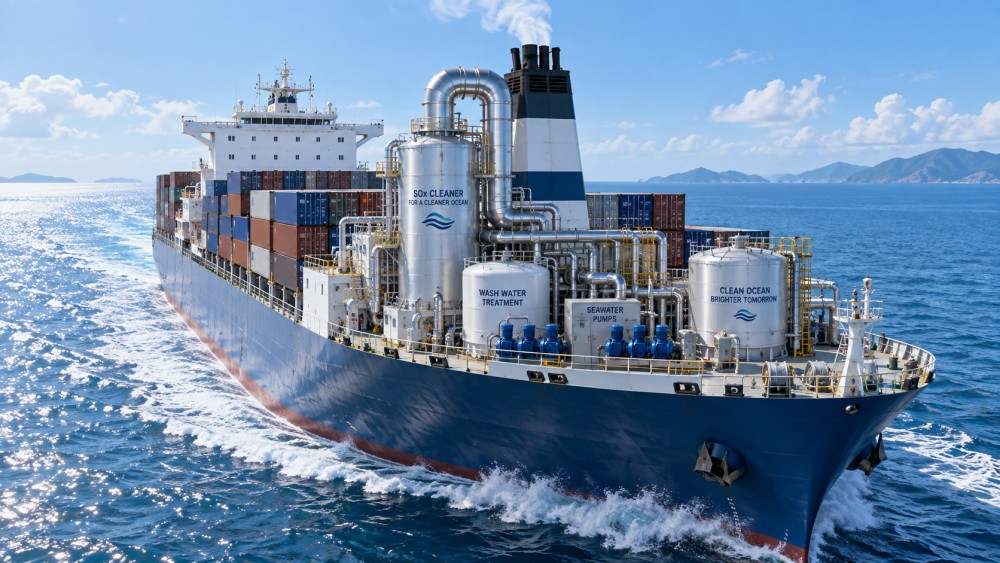
A frequent design issue is underestimating the consequences of tank sizing. A closed-loop unit may operate properly at the scrubber itself but create operational pressure elsewhere if storage capacity is insufficient for the voyage schedule. Tank capacity should be checked against realistic engine use, expected periods without discharge, process bleed rate, sludge generation, and port reception arrangements—not just an idealized route.
Hybrid arrangements: useful flexibility only when both modes are usable
A hybrid system is designed to operate in open-loop mode when discharge is permitted and in closed-loop mode when it is not. On paper, this is the most versatile marine exhaust cleaning configuration. In practice, it is also the option that requires the clearest operating discipline because it combines much of the equipment and maintenance responsibility of both approaches.
Hybrid selection is often justified when trading patterns cross multiple jurisdictions or when the vessel cannot reliably predict where discharge limitations will apply. It can reduce dependence on compliant fuel during many operating periods while preserving a closed-loop capability for restricted areas. But the technical review must verify that the closed-loop mode is sized for the duration and engine load expected in those areas. A nominal hybrid label does not guarantee that the vessel can remain in closed-loop operation for every intended port stay or maneuvering period.
Control logic deserves particular scrutiny. Operators need clear mode-change procedures, alarms that identify abnormal washwater or dosing conditions, and records that demonstrate proper operation. The transition between modes should be validated across the range of anticipated exhaust loads. A system that changes modes smoothly at steady propulsion load may behave differently when auxiliary engines are starting, boilers are cycling, or the main engine is maneuvering.
Dry and sorbent-based cleaning: specialized options with different constraints
Dry exhaust cleaning systems use alkaline sorbents rather than washwater to capture sulfur compounds. They eliminate washwater discharge concerns, which can make them relevant where liquid handling is impractical or discharge restrictions dominate the decision. They also avoid dependence on seawater properties.
The tradeoff shifts to consumables and residue handling. Sorbent storage, feeding equipment, residue collection, fire and dust considerations where applicable, disposal logistics, and machinery-space arrangement all require examination. The added mass and volume of consumables may be difficult to accommodate on vessels with long autonomous voyages or limited storage margins. These systems are therefore more commonly evaluated as specialized solutions than as a default choice for every ship type.
Engine integration issues that can alter the preferred option
The scrubber body is only one part of the installation. Exhaust backpressure is among the most important engine-side constraints. Added pressure losses through the scrubber, bypass arrangement, silencers, ducting, and any exhaust modifications must remain within engine-maker limits across the full operating range. The review should include fouling allowance and not rely only on clean-system calculations.
Exhaust temperature is another design boundary. Low-temperature operation can increase condensation-related risks, while high temperature can affect materials, cooling requirements, and system durability. Depending on the engine and arrangement, the project may require bypass ducts, insulation changes, structural modifications to the uptake, expansion joints, or reinforcement of supporting steelwork.
Where several exhaust sources are connected, the arrangement must prevent unfavorable interactions between engines. Uneven exhaust distribution, pressure imbalance, backflow risk, or poorly coordinated bypass logic can complicate both performance and maintenance. Separate scrubber trains may offer operational segregation, while a shared system may reduce equipment count but increase integration complexity. There is no universal preference; the answer depends on the engine-room layout, redundancy expectations, and simultaneous operating combinations.
Compliance depends on monitoring, records, and fallback capability
Marine exhaust cleaning is accepted as an equivalency pathway only when the vessel can demonstrate performance under the governing requirements. Continuous or periodic monitoring arrangements, depending on the applicable system and approval basis, are not administrative add-ons. They are part of the compliance function. Sampling points, sensor access, calibration routines, data recording, alarm handling, and protection against loss of power or communication should be reviewed during design.
A monitoring system that is difficult to maintain can become an operational liability. Sensors exposed to contaminated washwater, sample lines susceptible to blockage, and poorly located cabinets can generate repeated alarms or unreliable readings. Technical evaluators should ask how routine verification is performed at sea, what spares are required onboard, and what the vessel may do if a critical monitoring element fails.
The fallback arrangement matters just as much. If a scrubber is unavailable because of a pump failure, high backpressure alarm, washwater-quality issue, or planned maintenance, the vessel must still have a compliant operating route. That may involve switching to fuel that meets the applicable sulfur requirement, reducing the affected engine’s use, or operating under an approved contingency procedure. Fuel-changeover capability should therefore be preserved and tested even on vessels intended to rely primarily on exhaust cleaning.
Comparing the options against actual vessel conditions
Build the decision around lifecycle operability
Capital cost alone does not distinguish a sound choice from a problematic one. The evaluation should include electrical consumption, pump wear, chemical use where applicable, consumables, expected cleaning intervals, spare-parts strategy, tank-cleaning needs, sludge handling, crew workload, dry-dock scope, and downtime exposure. It should also account for fuel flexibility: the vessel may operate with different fuel types and sulfur levels over its service life, and the cleaning system must remain appropriate for those conditions.
Maintenance access is easy to overlook in a layout drawing. Spray headers, demisters, sensors, pump strainers, sample-conditioning equipment, and internal scrubber components need safe access for inspection. A compact installation that blocks access to essential components can increase maintenance duration and make planned work harder to complete at sea.
The most reliable selection process ends with a route-based operating matrix rather than a generic statement that one technology is “best.” Map each expected operating condition—open sea, coastal transit, berth, maneuvering, restricted-discharge area, and maintenance contingency—to an available compliance mode. When every row has a viable fuel, exhaust-cleaning, monitoring, and fallback arrangement, the chosen system is far more likely to deliver practical sulfur compliance instead of creating a new operational constraint.
Recommended News