
Industry News
Curation by industry experts
Hot Articles
Popular Tags
Industrial Generator Set Procurement: Evaluating Factory Tests
A factory test can show whether a generator package performs as agreed before it leaves the manufacturer’s premises. It cannot, by itself, prove that the installed system will start reliably with the site’s fuel supply, ventilation, switchgear and actual loads. For procurement teams, the useful question is not simply whether a set passed its factory acceptance test, but what was tested, under which conditions, and what remains to be verified after delivery.
That distinction affects contract value. A low-priced package may become expensive if performance limits, controls interfaces or corrective work are discovered during commissioning. A well-defined test plan gives both buyer and supplier a common basis for resolving those issues before shipment.
Translate the operating duty into testable requirements
Start with the intended use. A backup gas generator may spend long periods stationary, then need to start and accept essential loads after a power interruption. A continuous-duty installation faces a different operating profile: sustained output, fuel consumption, maintenance intervals and the effect of ambient conditions may carry more weight than a short demonstration of maximum power.
Before requesting a factory acceptance test, or FAT, document the expected electrical load profile, operating hours, available gas composition and pressure range, site elevation, ambient temperatures and cooling arrangement. Identify large motors, variable loads and other equipment that could cause substantial load steps or voltage and frequency disturbances. The supplier should state which requirements can be demonstrated at the factory and which depend on site conditions or separate engineering analysis.
For an industrial generator set, the purchase specification should identify the complete package being evaluated: prime mover, alternator, generator control system, starting equipment, cooling components and any supplied switchgear. A test of the engine alone is not equivalent to a test of the assembled package. If the final alternator or controller is unavailable for the test, the resulting limitation should be recorded rather than hidden within a general pass statement.
Specify the applicable rating and its operating assumptions in the contract. Ask the supplier to identify the rating basis, permitted operating conditions and any power reduction expected at the proposed site. A factory test conducted under more favorable conditions may confirm performance at the factory but cannot automatically establish available output at a hot, elevated or poorly ventilated site.
Agree on the FAT procedure before production is complete
A test procedure is more useful when it is approved before the equipment is ready to run. At that point, the buyer can still negotiate practical changes to the test setup, instrumentation and acceptance criteria. Leaving the procedure until the shipping date encourages disputes over whether a missing demonstration was included in the price.
The document should identify the equipment by model and serial number where available, list the test equipment and describe its calibration status. It should also state the sequence, load levels, duration, readings to be recorded and conditions for a pass, retest or deviation. Acceptance limits need a contractual source: the purchase specification, an agreed manufacturer guarantee or an identified applicable standard.
ISO 8528-5 addresses generating sets powered by reciprocating internal combustion engines and includes performance requirements and test methods. Its applicability depends on the machine type and the edition specified in the contract; it should not be assumed to cover a gas-turbine package merely because the package generates electricity. Contract documents should identify the relevant standard and clauses rather than refer vaguely to “international standards.” Source: International Organization for Standardization, ISO 8528-5, Reciprocating internal combustion engine driven alternating current generating sets — Part 5: Generating sets.
Examine the load test, not just the pass certificate
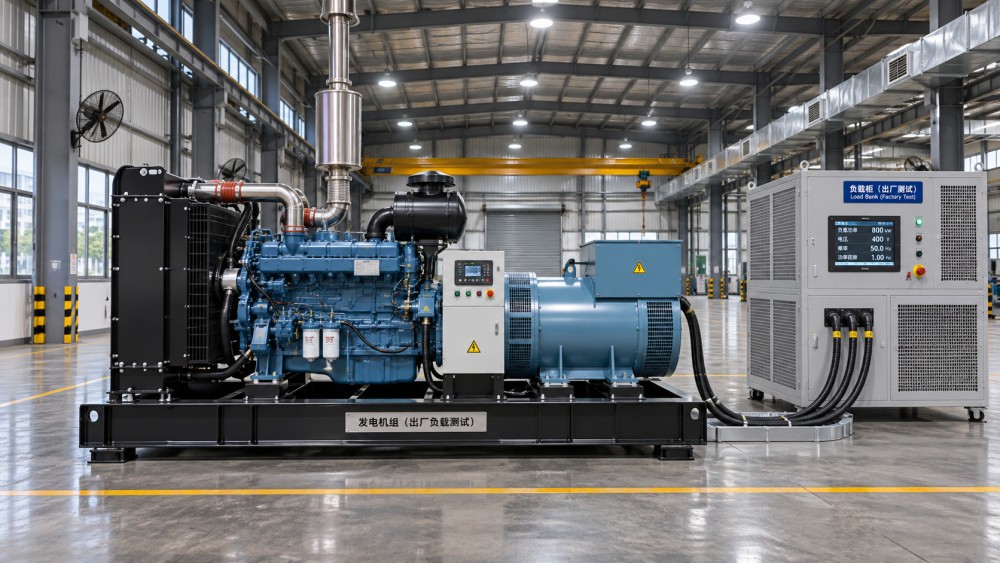
A load bank provides a controlled electrical demand, making it useful for checking output and observing operating behavior. The test report should show the actual load applied over time, rather than only a final signed result. Useful observations include voltage, frequency, current, power, relevant temperatures and pressures, together with the ambient and fuel conditions during the run.
Review whether the sequence reflects the proposed duty. A stable-load run can reveal different issues from repeated starts or sudden changes in demand. For a backup application, the buyer may request demonstrations of starting, load acceptance and recovery after a step change. For continuous service, an agreed sustained run at the specified operating point may be more informative than a brief peak-output demonstration. The precise steps and duration should be negotiated around the equipment rating and project risks; there is no universal FAT sequence that fits every order.
Ask what type of load the factory can apply. A resistive load bank is useful, but it does not reproduce every characteristic of motors, electronic drives or a plant distribution system. If reactive loading, nonlinear loads or a particular transient is material to the project, the parties should agree on a suitable test, simulation or engineering review. A supplier should not be asked to claim that an untested site load has been reproduced.
When comparing bids, check whether fuel consumption is guaranteed at a defined output and fuel condition or merely provided as an estimate. A meaningful comparison identifies the measurement method, fuel properties, auxiliary loads included and correction method. Gas quality at the site may differ from the factory supply, so the contract should explain how those differences affect evaluation rather than treating two consumption figures as directly interchangeable.
Test the generator control system as an operating system
The controller connects electrical performance to the way operators will actually use the equipment. Its FAT should cover the agreed operating modes, indications, alarms, shutdown functions and interfaces—not just whether the display turns on. Purchasers should request an input/output list and a cause-and-effect schedule that identifies what the controller is expected to do when each selected condition occurs.
Where safe and technically appropriate, the supplier can demonstrate selected conditions by simulation or by an agreed test method. The report should distinguish an actual sensor response from an injected signal or simulated fault. A simulated low-pressure input, for example, may show that the controller acts on a signal; it does not necessarily prove the entire field sensing arrangement under real operating conditions.
For automatic backup operation, confirm the intended starting logic, permissives, transfer interface and reset behavior. If paralleling or load sharing is part of the order, agree on how synchronization, breaker commands and load-sharing functions will be demonstrated. A factory without the necessary companion equipment may be able to test only part of that sequence. Record the gap and include the complete demonstration in the site acceptance plan.
Remote monitoring also needs a defined boundary. The supplier should identify the supplied communication protocol, connection points, available signals and responsibility for integration with the purchaser’s supervisory system. Testing data exchange with a factory simulator is useful, but it is not the same as validating the final network, cybersecurity configuration or site-specific alarms.
Separate factory evidence from site acceptance
The FAT takes place in a controlled environment with temporary services and test equipment. The installed generator will depend on permanent fuel piping, ventilation, exhaust, foundations, cabling and protection settings. Those interfaces can change the outcome even when the factory test is satisfactory.
Use a responsibility matrix to distinguish supplier work, purchaser work and third-party work. For each critical item, state the evidence required and the point at which it will be accepted:
- Fuel supply: Confirm design assumptions and required gas conditions before manufacture; verify the installed supply and its interfaces during commissioning.
- Electrical integration: Review connection drawings and protection requirements before shipment; test the installed switchgear and transfer or paralleling sequence at site where applicable.
- Cooling and exhaust: Review supplier limits and installation requirements in advance; verify the completed site arrangement against the approved design.
- Controls: Demonstrate agreed functions at the factory and repeat integrated functions with the actual site equipment where necessary.
Site testing should be performed under an approved procedure by qualified personnel, with the relevant isolation, fuel-handling and electrical safety measures established for the installation. The applicable legal and technical requirements depend on jurisdiction and system design. For electrical safety in US workplaces, purchasers can consult the Occupational Safety and Health Administration, 29 CFR 1910 Subpart S, Electrical; local requirements may differ or add obligations.
Make deviations and retests part of the commercial agreement
A test failure is not the only reason to withhold acceptance. Missing readings, substitute components, uncalibrated instruments or a test performed outside the agreed conditions can leave the buyer without enough evidence to decide. The purchase order should explain who can approve a deviation, what documentation is required and whether corrective work triggers a repeat test.
Define witness points and notice periods so the buyer or an appointed inspector can attend important demonstrations. If attendance is waived, the supplier should still provide the agreed raw records and report. The contract can also identify hold points at which shipment must not proceed until specified issues are resolved or formally accepted.
Allocate the cost of retesting according to the reason for it. A repeat caused by equipment failing an agreed acceptance criterion is different from a buyer-requested change to an approved procedure. Likewise, a defect that cannot be corrected before a scheduled shipment needs a documented disposition, an owner and a deadline; it should not disappear into an unsigned punch list.
What purchasers should retain at handover
The final package should connect the physical equipment to the evidence: serial numbers, approved test procedure, instrument records, test data, deviations, corrective actions and the signed report. Retain relevant drawings, settings, operating instructions, maintenance requirements and spare-parts information alongside it. Where software or controller settings were changed after the FAT, record the change and determine whether affected functions need retesting.
The strongest procurement decision is based on traceable evidence rather than a certificate alone. If the factory could not reproduce a critical operating condition, that is not automatically a reason to reject the equipment. It is a reason to define the remaining risk, assign responsibility and make the corresponding site test a clear condition of acceptance.
Recommended News