
Industry News
Curation by industry experts
Hot Articles
Popular Tags
Why Gas Turbine Start-Up Reliability Matters in Industrial Backup Power Planning
Backup power planning often starts with a simple question: how much capacity is needed if the grid fails? For project managers and engineering leads, that question is incomplete. Capacity only matters if the equipment can start, synchronize, and carry load when the plant actually needs it. In many industrial sites, the real exposure is not a lack of installed megawatts but a mismatch between emergency timelines and generator start-up behavior.
That is why start-up reliability deserves attention early in the design phase, especially when a gas turbine is being considered for standby duty, peaking support, or black-start related strategies. A unit that offers strong efficiency or attractive output on paper may still create operational risk if its cold-start time, fuel readiness, auxiliary dependencies, or restart performance do not match the site’s outage scenarios.
Backup power failure is usually a timing problem before it becomes a power problem
Industrial outages rarely affect only one system. When incoming power is lost, pumps may stop, instrument air may decay, cooling loops may change state, and process control logic may shift equipment into safe shutdown sequences. In that environment, the question is not merely whether a backup source can run. It is whether it can start reliably within the window that prevents a controlled upset from becoming equipment damage, product loss, safety exposure, or a prolonged restart of the entire facility.
Different industries feel this timing pressure in different ways. A water treatment plant may need rapid restoration for critical pumping and controls. A manufacturing line may tolerate a short gap for nonessential loads but not for environmental systems, material handling, or thermal processes that are difficult to stabilize once interrupted. A petrochemical or gas processing site may require staged power recovery so seal systems, lubrication packages, compressors, and flare-related support loads return in the right order.
In each of those cases, start-up reliability shapes the value of the backup asset far more than nameplate output alone.
Why start-up reliability is a distinct evaluation item
Teams sometimes treat generator reliability as a single metric. In practice, there is a useful distinction between running reliability and start-up reliability. A machine may operate steadily once online yet still fail its intended purpose if it has a low probability of successful start under emergency conditions.
Start-up reliability depends on more than the prime mover itself. It includes the condition of batteries or starter systems, lube oil preheating, fuel gas pressure stability, purge sequencing, control logic integrity, sensor health, auxiliary power arrangements, and the condition in which the machine sits before an event. A well-maintained unit in warm standby is not exposed to the same risks as one that remains idle for long intervals and is expected to start from a cold state after months of minimal use.
For project leaders, this distinction matters because backup power plans are often approved based on capacity calculations and high-level redundancy diagrams, while the start sequence receives less scrutiny until commissioning or, worse, the first real outage.
Where gas turbine backup systems fit—and where planning often goes wrong
Gas turbine-based backup systems can be appropriate in industrial environments where fast response, compact power density, fuel flexibility within the site’s infrastructure, or integration with broader generation strategy are important. They may be considered for captive power plants, large utility support loads, remote process facilities, and sites that already handle gaseous fuels as part of normal operations.
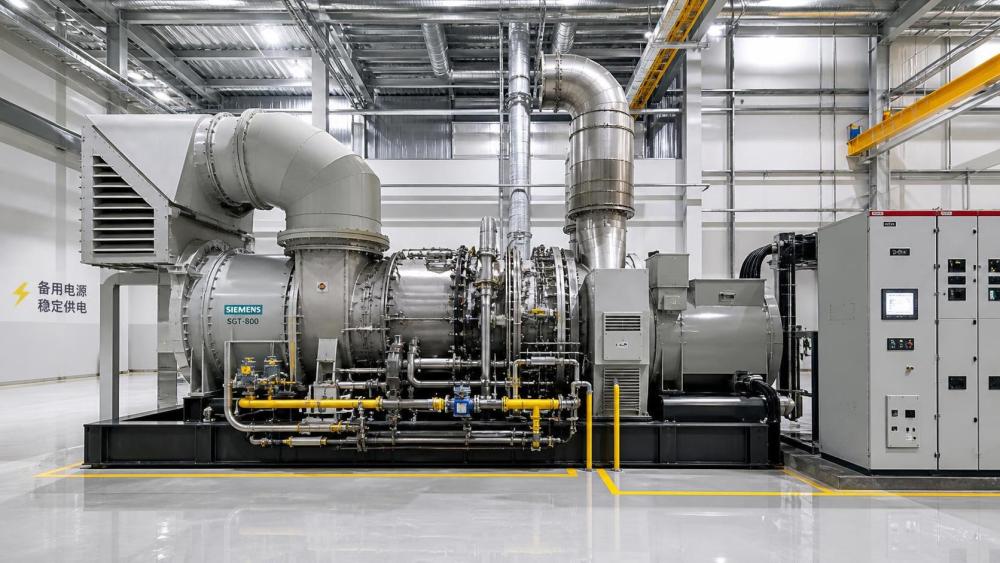
When teams review a Gas Turbine option for backup duty, the key issue is not only output range or thermal performance. The more practical question is whether the selected configuration can move from standby condition to stable load acceptance under the site’s actual emergency logic. That requires attention to start mode, ambient conditions, fuel treatment, auxiliary systems, and the level of operator intervention assumed during a disturbance.
A common planning mistake is to assume that any installed turbine can support all backup scenarios equally well. In reality, emergency support, peak shaving, spinning reserve, and black-start support can place very different demands on the machine and on the plant around it.
Cold start, warm start, and hot restart are not interchangeable
Project documents often mention start time as if it were a single number. It is not. Start performance usually changes according to prior operating condition.
- Hot restart may be relatively fast because residual heat and system readiness reduce the time needed to reach firing and loading conditions.
- Warm start can be slower and may involve tighter control of thermal gradients.
- Cold start generally presents the greatest challenge because auxiliaries, lubrication condition, clearances, purge requirements, and component temperatures all differ from a recently running unit.
This matters during contingency planning because real outages do not always happen while the machine is in a favorable thermal state. If a site depends on the unit after an extended idle period, the cold-start profile is often the relevant benchmark. If the backup system is expected to re-energize loads after a short trip, warm or hot restart behavior may matter more. The procurement team needs those distinctions written clearly into technical specifications and factory or site acceptance criteria.
Auxiliary systems often determine whether the turbine starts at all
Prime mover selection tends to receive most of the attention, but many start-up failures originate in support systems. That is especially important in industrial projects where packages are integrated from multiple vendors or where existing balance-of-plant equipment is reused.
Fuel system readiness
Gas quality, pressure, filtration, heating requirements, and shutoff valve response can all influence successful ignition and acceleration. If backup operation depends on a fuel gas network that also loses pressure or control integrity during the same electrical event, the turbine may not start as assumed. Sites using dual-fuel strategies need to check transfer logic, storage conditions, and emission-related constraints during emergency operation.
Lubrication and turning gear conditions
Bearings and rotating assemblies require proper lubrication state before start. Extended idle periods can create issues with oil temperature, contamination, seal condition, or pre-lube sequencing. Where turning gear or rotor barring systems are required, their readiness becomes part of the backup power risk profile.
Starting power and control power
A turbine may still need reliable DC control power, battery-backed logic, or an independent means of starting auxiliaries after a grid disturbance. If the emergency design assumes healthy batteries but maintenance routines do not verify them under realistic discharge conditions, the turbine’s apparent availability may be overstated.
Inlet and ambient condition management
Dust, humidity, temperature extremes, salt exposure, and icing potential can all influence start behavior. For outdoor installations or harsh industrial environments, enclosure design and preservation practices can be as important as the machine selection itself.
Load acceptance can be as important as start time
A successful ignition sequence does not guarantee effective backup support. Some facilities need the generator to pick up critical loads in stages; others need immediate support for motor starting, compressor auxiliaries, controls, or heat-tracing systems. If the turbine reaches rated speed but cannot accept the required block load or ramp without instability, the outage impact may still be severe.
Project teams should test their assumptions around:
- minimum stable load after synchronization
- ramp rate under expected ambient and fuel conditions
- motor starting strategy for large drives
- sequential restoration logic for critical and noncritical buses
- interaction with UPS systems, load shedding, and process interlocks
These details affect whether the backup source supports a graceful recovery or simply adds another unstable element to an already stressed system.
Procurement language should reflect outage reality, not brochure language
Many backup power packages are weakened by vague tender requirements. If the specification only asks for “reliable emergency operation,” suppliers may respond with standard package assumptions that do not match the site’s actual risk profile.
Procurement documents are stronger when they define the operating context in practical terms: expected start condition, maximum allowable time to first power, required load pickup sequence, available fuel during outage, ambient extremes, idle periods between starts, and whether the machine must support islanded operation or black-start related functions.
For project managers, the issue is not writing a longer specification for its own sake. It is reducing ambiguity that later turns into change orders, integration disputes, or disappointing site performance.
A useful review structure during bid evaluation includes:
Commissioning should simulate credible failure scenarios
Industrial backup systems are often commissioned under relatively controlled conditions: stable fuel supply, full staffing, favorable weather, and a prepared test script. Real outages do not arrive that way. Commissioning plans should therefore include scenario-based verification, not just normal sequence confirmation.
That can include testing after extended standby periods, validating automatic sequence transitions, checking response to failed auxiliaries, and confirming that critical loads reconnect in the intended order. Even where full live-load testing is limited by site constraints, control logic and interdependency checks can still reveal weak points before handover.
One of the most expensive assumptions in project delivery is believing that successful first-fire proves emergency readiness. It proves only that the unit can run under one set of conditions.
Maintenance strategy influences planning value from day one
Start-up reliability is not preserved automatically after installation. Standby assets are exposed to a specific maintenance challenge: they spend long periods not proving themselves under true emergency conditions. Components that matter most during start, such as batteries, valves, ignition devices, sensors, and fluid conditioning systems, may degrade quietly.
This is why project teams should think past capital delivery and ask how the operator will preserve readiness. The maintenance concept should align with how the turbine will actually be used. A unit intended for frequent peaking support has a different inspection rhythm and data profile from one reserved mainly for emergency events. If the owner lacks the staffing or procedural discipline to sustain warm-standby readiness, design assumptions may need to be adjusted rather than left as a paper commitment.
How project teams can make better decisions early
For engineering and project leadership, the most useful approach is to connect outage consequences to machine behavior in a structured way. Start by defining what must stay alive, what can drop, and how long each critical system can tolerate interruption. Then evaluate whether the proposed backup configuration can meet that timeline under realistic start conditions, not ideal ones.
Questions worth raising during front-end engineering and vendor review include:
- What is the required time to first critical load, not just full output?
- Which auxiliaries must be healthy before the turbine can start?
- What changes between cold, warm, and hot starts?
- How does ambient temperature affect start permissives and loading?
- What periodic tests are needed to preserve actual readiness?
- Which failure modes would prevent a successful automatic start?
Those questions help shift the discussion from equipment rating to operational resilience. In backup power planning, that shift is often where major risk reduction happens. A turbine package can be technically sound and still fail the site’s emergency mission if start-up reliability was treated as a secondary detail. For industrial projects where outages carry process, safety, and recovery consequences, the real measure of backup value begins at the moment the machine is asked to start.
Recommended News