
Industry News
Curation by industry experts
Hot Articles
Popular Tags
When Should a Gear Reducer Be Rebuilt Instead of Replaced?
When Should a Gear Reducer Be Rebuilt Instead of Replaced?
When should a gear reducer be rebuilt instead of replaced? For engineering and procurement teams, the answer depends on more than repair cost: housing integrity, gear and bearing condition, downtime exposure, parts availability, and future load requirements all influence the decision. Rebuilding can preserve a serviceable asset and avoid costly installation changes, while replacement may be preferable when damage is extensive or operating demands have changed.
The strongest rebuild candidate is not simply an old gearbox with an affordable repair quote. It is a unit whose core geometry remains recoverable, whose original rating still fits the application, and whose failure mechanism can be corrected. If those conditions are missing, rebuilding may only postpone a more expensive shutdown.
Start with the failure mechanism, not the purchase price
A leaking seal, rising vibration, or metal in the oil is a reason to investigate—not an automatic reason to replace the reducer. These symptoms can originate from relatively contained wear, but they can also signal damage extending through bearings, shafts, gears, and bearing seats.
Before teardown, preserve the evidence. Record vibration trends, operating temperatures, lubricant condition, load history, and recent changes to the driven equipment. Oil analysis and debris inspection can help direct the investigation, although neither replaces dimensional inspection. For a critical asset, inspection and removal should follow site isolation procedures and the manufacturer's guidance.
The key question is whether the failure came from normal wear or an unresolved operating problem. A bearing damaged by contaminated oil may justify a rebuild if the contamination path is eliminated. Repeated gear distress after throughput increases points toward a capacity mismatch. Installing another reducer with the same rating would not necessarily solve that problem either.
Ask for a failure explanation that connects physical findings with operating conditions. “Replace bearings and seals” is a work scope, not a root-cause assessment.
The inspection findings that make rebuilding credible
A rebuild normally involves disassembly, cleaning, measurement, replacement or approved restoration of damaged components, reassembly, and testing. It is more substantial than changing an external seal, but the term alone says little about the quality or completeness of the work.
Housing and bearing seats
The housing establishes the relationship between shafts. Its bearing bores, mating surfaces, and mounting features must retain—or be restored to—the required geometry. A sound casting with localized, repairable bore wear can be a reasonable rebuild foundation. Cracks, severe distortion, or extensive damage around critical supports demand a more cautious assessment.
Housing repair is not automatically unacceptable, but it needs an engineered procedure and dimensional acceptance criteria. A low-cost repair that leaves shaft centers misaligned can compromise new gears and bearings from the first operating cycle.
Gears, shafts, and bearings
Inspect gear flanks for pitting, scuffing, abnormal contact patterns, and material loss; examine tooth roots for cracking using suitable methods where warranted. Damage severity must be assessed against the gear design, operating duty, and manufacturer or specialist criteria. Visible surface marks alone are not a reliable remaining-life estimate.
Shaft journals, shoulders, splines, and keyways also matter. A damaged bearing fit or cracked shaft can turn an apparently straightforward bearing replacement into a larger restoration project. Bearing condition should be interpreted alongside lubrication, fits, preload or clearance, and evidence of electrical damage where relevant.
Replacement gears must be compatible with the mating components. Matching tooth count and nominal dimensions is insufficient: tooth geometry, material, heat treatment, accuracy, and contact requirements affect performance. In some designs, replacing the gear pair or set is more appropriate than replacing one damaged member.
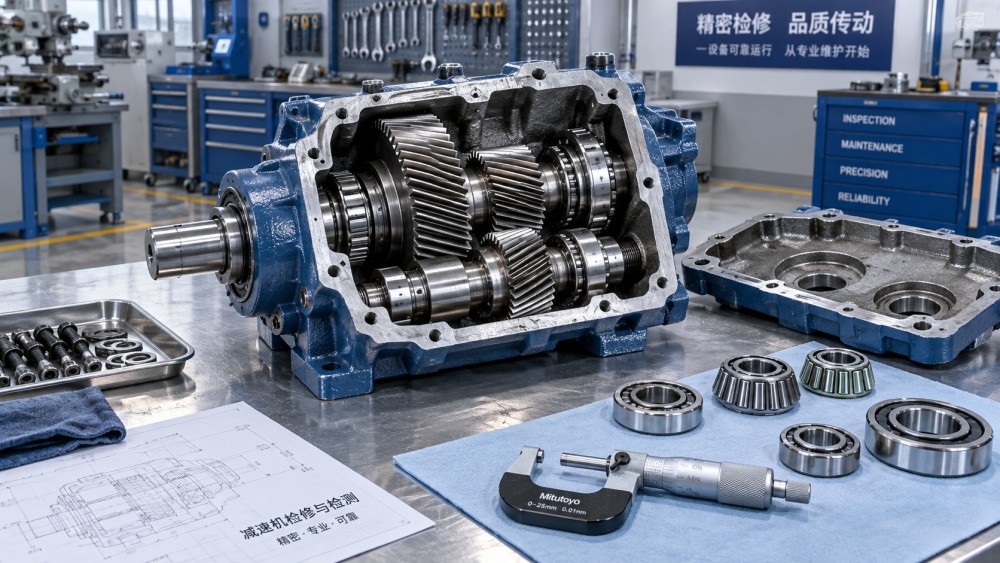
A useful inspection report separates reusable, repairable, and replacement-only components, with measurements and photographs supporting each decision. That distinction makes the rebuild quote auditable rather than speculative.
Check whether the original reducer still fits the job
A gearbox can be mechanically rebuildable and still be wrong for its current application. Production changes often happen gradually: a conveyor carries more material, a mixer handles a more viscous product, or a variable-speed drive introduces operating speeds outside the original assumptions.
Reconfirm actual input power and speed, output torque, ratio, starting loads, shock loads, reversals, and operating hours. Include radial and axial shaft loads, especially where belts, chains, or overhung equipment are involved. Motor nameplate power alone does not establish the reducer's suitability.
Thermal capacity deserves separate attention. A reducer may satisfy mechanical torque requirements yet overheat under continuous duty, high ambient temperature, restricted airflow, or unsuitable cooling arrangements. At low input speeds, verify lubrication delivery rather than assuming the original splash system remains adequate.
For precision drives, backlash, torsional stiffness, and positioning performance may govern the decision. A rebuild acceptable for a bulk conveyor may not meet the repeatability needs of an indexing machine. Define the required performance before authorizing work.
Compare installed costs—not two equipment quotes
There is no universal repair-cost percentage that determines when replacement becomes better. Such rules overlook installation complexity, remaining asset life, and the consequences of another failure.
A rebuild estimate should include teardown, inspection, components, machining, assembly, testing, freight, removal, reinstallation, alignment, and commissioning. Identify which costs are firm and which depend on findings after disassembly. An attractive preliminary price can change substantially when damaged gears or bearing bores are discovered.
Replacement brings its own costs. A new unit may require a different baseplate, coupling, shaft connection, lubrication system, guard, or instrumentation interface. Even a nominally equivalent reducer should be checked for mounting dimensions, shaft positions, rotation, ratio, and allowable external loads.
Compare both options over a common planning horizon. Include expected maintenance, energy use where supportable, spare-parts needs, and the cost of credible failure scenarios. Do not assign an efficiency benefit to replacement without comparable performance information under the actual duty.
For a plant approaching retirement, a well-supported rebuild may fit the remaining service period. For a long-life installation with repeated failures and obsolete components, replacement may offer a more defensible lifecycle decision despite higher initial expenditure.
Downtime and parts availability can reverse the decision
An available replacement can be preferable to an uncertain rebuild when production has no redundancy. Conversely, rebuilding an existing custom reducer may avoid a long new-equipment delivery and substantial interface modifications. Neither outcome should be assumed before checking schedules.
Request separate commitments for inspection turnaround, component supply, machining, assembly, and testing. A short workshop schedule means little if a gear set has not been sourced. For obsolete units, confirm whether drawings, material specifications, and manufacturing capability exist before treating reproduction as routine.
A two-stage authorization can control uncertainty: approve teardown and assessment first, then approve the rebuild against an agreed scope and cost ceiling. Set a decision deadline so the asset does not remain dismantled while procurement debates alternatives.
Where downtime dominates the economics, a spare or exchange unit may change the calculation. Rebuilding the removed gearbox as a standby asset can be practical, provided its configuration, storage requirements, and readiness are documented.
Require evidence that the rebuilt unit is ready for service
The acceptance plan should be agreed before work begins. Depending on the reducer, it may include dimensional records, bearing setup, backlash and contact checks, lubrication verification, leak checks, and recorded vibration and temperature during testing. Applicable tolerances must come from the design documentation or an agreed engineering specification.
A no-load test can reveal assembly problems, but it cannot demonstrate full-load thermal performance or every load-dependent defect. If representative load testing is unavailable, state that limitation and define the on-site commissioning checks needed to close it.
Warranty scope also needs clarity: covered components, duration, operating conditions, exclusions, and responsibility for removal and transport. A warranty is not a substitute for inspection evidence, and its practical value depends on what happens if the unit fails again.
After installation, establish a new vibration and temperature baseline under recorded operating conditions. Correct coupling alignment, foundation problems, contamination routes, and lubrication deficiencies identified during the investigation. Otherwise, the rebuilt reducer may return to the same damaging environment.
A defensible decision rests on three conditions
Rebuilding is usually worth pursuing when the structure and geometry are recoverable, the reducer remains correctly rated for future duty, and qualified parts and workmanship are available within the required outage. Replacement becomes more compelling when structural damage is extensive, operating demands exceed the design, or restoration cannot deliver a verifiable result on an acceptable schedule.
Within its Precision Reducers & Power Transmission pillar, The Global Power-Plant & Engine-Tech (G-PPE) provides a technical benchmarking perspective that connects component condition with wider power-asset decisions. For equipment supporting industrial engines, turbines, and other critical systems, that means evaluating the reducer as part of the drivetrain—not as an isolated purchase. Standards and acceptance requirements should be selected for the actual equipment and application, rather than borrowed from unrelated power technologies.
Before approval, assemble three documents: the condition report, the confirmed operating-duty requirements, and a side-by-side installed-cost and delivery comparison. If the rebuild proposal cannot explain what failed, how the cause will be corrected, and how performance will be accepted, the decision is not yet ready.
Recommended News