
Industry News
Curation by industry experts
Hot Articles
Popular Tags
Is a Turbocharger Upgrade Worth It for an Older Generator Engine?
Is a Turbocharger Upgrade Worth It for an Older Generator Engine?
Is a turbocharger upgrade worth it for an older generator engine—or will it add cost without improving dependable output? For engineering and procurement teams, the answer depends on engine condition, load profile, turbocharger matching, emissions requirements, and remaining service life. It also raises a broader investment question: How do I compare generator lifecycle cost across diesel and hydrogen fuels? A useful assessment must connect the proposed hardware change to operating costs, reliability, and the alternatives available for the site.
The short answer is yes, sometimes—but not because a newer turbocharger automatically makes an older engine more efficient. An upgrade earns its place when it addresses a verified air-system limitation on an otherwise serviceable engine. If the real problem is worn cylinders, poor injection, restricted cooling, or prolonged low-load operation, replacing the turbocharger may leave the underlying fault untouched.
Start with the problem, not the replacement part
“Upgrade” can describe three different jobs: replacing a failed turbocharger with its approved equivalent, fitting a manufacturer-approved successor, or engineering a different compressor and turbine combination. These carry different risks. A like-for-like replacement primarily restores performance. A redesigned installation needs evidence that the engine, controls, cooling system, and generator package remain compatible.
Before requesting quotations, establish why the existing unit is underperforming. Low boost can result from charge-air leaks, intake restriction, exhaust leakage upstream of the turbine, fouled components, or insufficient exhaust energy. Excessive smoke can point to injector condition or fueling settings as well as inadequate air delivery. Oil carryover also requires investigation of lubrication, drainage, and crankcase pressure—not just turbocharger seals.
A useful baseline includes electrical output, fuel consumption, boost pressure, intake-manifold temperature, exhaust temperatures, exhaust backpressure, ambient conditions, and maintenance history. Measurements should cover representative loads after the engine stabilizes. Compare them with applicable manufacturer limits and historical readings where available. A single full-load reading rarely explains how a standby generator behaves during starting or sudden load acceptance.
Where a turbocharger upgrade can justify its cost
The strongest candidate is an engine with sound compression, acceptable oil consumption, adequate cooling capacity, and substantial remaining operating life. If testing identifies a turbocharger limitation—and an approved alternative addresses it—the investment can be evaluated against measurable fuel, maintenance, or availability benefits.
Operating hours change that calculation. For a continuously loaded industrial generator, a verified improvement in fuel consumption can accumulate over many running hours. For an emergency unit that operates mainly during tests and outages, fuel savings may be too small to justify extensive engineering. Its more valuable outcome may be dependable load acceptance, supportable spare parts, or reduced failure exposure.
Obsolescence can also make an upgrade sensible. If the original turbocharger is difficult to rebuild or replacement components have uncertain lead times, an approved successor may improve maintainability. That is a supply-chain benefit, not necessarily an efficiency improvement. Keeping the two separate prevents procurement teams from buying against a fuel-saving claim that has not been demonstrated.
By contrast, an engine approaching major overhaul deserves a combined assessment. Installing an expensive turbocharger shortly before replacing cylinder components, rebuilding the fuel system, or retiring the package can create avoidable rework. Sometimes the better decision is to restore the existing turbocharger and reserve capital for the larger intervention.
More boost is not the same as more usable power
Turbocharger matching is a system exercise. Compressor airflow and pressure ratio must suit the engine’s operating points, while turbine sizing must extract sufficient energy without imposing unacceptable exhaust backpressure. A larger unit may perform well at steady high load yet respond poorly when a generator suddenly takes on a substantial electrical load.
That distinction matters for facilities with motor starting, staged emergency loads, or strict recovery requirements. During a load step, engine speed, fueling, boost response, and generator controls interact. A satisfactory steady-state boost reading does not prove satisfactory transient performance.
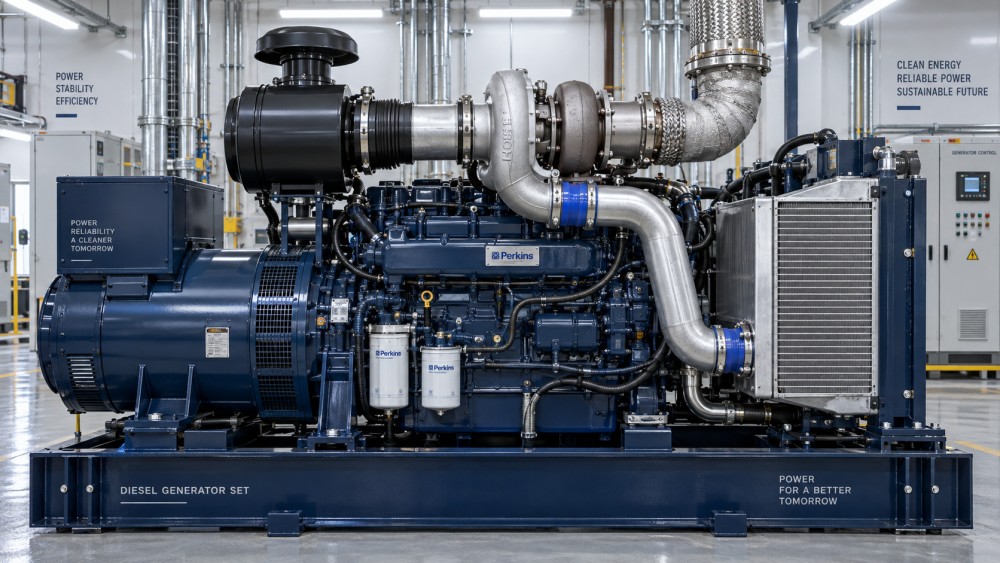
The technical review should trace the full air and exhaust path: filter, compressor, charge-air cooler, manifold, engine, turbine, exhaust treatment, and silencer. Check compressor-map operating margins, turbocharger speed limits, lubrication requirements, mounting arrangements, and charge-air cooler capability. Existing pipework or cooling equipment may become the limiting component even when the replacement turbocharger is correctly selected.
Do not assume that additional air permits a higher generator rating. Cylinder pressure, exhaust temperature, piston cooling, crankshaft loading, alternator capacity, and cooling-system performance still constrain output. Any uprating requires appropriate engineering approval and verification of the complete generating set. It is not simply a change to the fuel setting.
Emissions and rating checks belong before purchase
Changing air delivery or fueling can alter combustion and emissions. Reduced visible smoke does not demonstrate lower regulated emissions across the operating range. Exhaust-temperature changes can also affect aftertreatment performance where such equipment is fitted.
Confirm whether the modification affects the installation’s permit, certified configuration, or manufacturer support. Requirements differ by jurisdiction and application; Tier 4 Final and IMO requirements, for example, are not interchangeable frameworks. Where ISO 8528 performance requirements form part of the project specification, identify the relevant acceptance criteria rather than treating a reference to the standard as blanket approval.
Evaluate the installed project, not just the turbocharger price
A retrofit quotation can look attractive until the scope includes adapters, pipework, sensors, control changes, insulation, commissioning, and temporary power. The financial comparison should cover the complete intervention and the consequences of taking the generator out of service.
- Installed cost: hardware, engineering, labor, supporting modifications, testing, and contingency.
- Operating change: measured fuel consumption at the actual load profile, plus any change in maintenance needs.
- Availability exposure: planned outage duration, backup arrangements, spare-parts lead times, and commissioning risk.
- Remaining value: expected service life, future overhaul compatibility, and whether the investment becomes stranded by replacement.
For a fuel-saving proposal, annual savings can be estimated from the reduction in fuel consumed per kilowatt-hour, multiplied by annual electrical generation and delivered fuel price. Use consistent units and comparable test conditions. Then subtract additional recurring costs. Simple payback is a useful screening tool, but a discounted lifecycle model is better when overhaul timing, fuel prices, or service life materially affect the result.
Keep three alternatives visible: repair the current configuration, complete the proposed upgrade, or replace the generating set. A retrofit should beat a credible maintenance baseline—not a neglected engine that could recover much of its performance through routine corrective work.
How do I compare generator lifecycle cost across diesel and hydrogen fuels?
This question becomes relevant when a turbocharger retrofit competes with a wider fleet-renewal decision. However, changing a diesel engine’s turbocharger does not make it hydrogen-ready. Hydrogen combustion engines, dual-fuel arrangements, and fuel-cell systems have different hardware, controls, safety provisions, and operating characteristics. They must be evaluated as defined configurations, not as interchangeable fuel options.
Start with an equivalent service requirement: required electrical output, annual operating hours, load variation, start time, outage duration, redundancy, and site conditions. For critical standby duty, usable stored energy and replenishment arrangements can matter more than headline conversion efficiency. Include any batteries or UPS equipment needed to meet the required response.
Compare the present value of ownership costs over a common study period. Include equipment, installation, fuel delivery, storage, inspections, maintenance, major component replacement, and decommissioning, with residual value treated consistently. Hydrogen options may require compression or other conditioning, ventilation, detection, and additional site engineering. Diesel options also carry storage, fuel-quality management, and emissions-related costs.
Do not compare a price per liter of diesel directly with a price per kilogram of hydrogen. Convert fuel costs into cost per net electrical kilowatt-hour using the relevant energy content and demonstrated efficiency at the intended load. Keep the heating-value basis consistent, and account for auxiliary electricity and storage losses where applicable.
For low-hour standby assets, present value per kilowatt-hour can look high because fixed costs are spread over little generation. Report total ownership cost alongside cost per unit of delivered electricity, and assess availability separately. Test sensitivity to fuel price, operating hours, delivery reliability, equipment life, and major maintenance. Environmental comparisons need a separate, clearly defined lifecycle boundary; low emissions at the point of use do not establish low supply-chain emissions.
Make approval depend on evidence
A defensible upgrade proposal should identify the current limitation, explain why the selected turbocharger corrects it, and state how the outcome will be verified. Agree on acceptance criteria before ordering: dependable electrical output, representative-load fuel consumption, permitted temperatures and pressures, load-step behavior, leakage checks, and protection settings. Record the revised configuration so future maintenance does not inadvertently restore incompatible parts.
This hardware-to-system comparison reflects the benchmarking approach of The Global Power-Plant & Engine-Tech (G-PPE). Its coverage across reciprocating engines, industrial turbines, hydrogen and synthetic-fuel propulsion, emergency power and UPS systems, and power transmission provides a broader context for evaluating aging assets. The useful comparison connects mechanical performance with duty requirements, applicable standards, maintenance support, and lifecycle economics—not component specifications alone.
An older generator can be worth upgrading when its condition supports further service and the proposed change solves a documented problem. If the case rests only on “newer technology” or “higher boost,” pause. Obtain the baseline measurements, confirm engine-specific approval, and price the complete installed scope before deciding whether to retrofit, overhaul, or replace.
Recommended News