
Industry News
Curation by industry experts
Hot Articles
Popular Tags
Dual-Fuel Industrial Engines: Fuel Switching, Emissions, and Derating Explained
A dual-fuel engine can appear straightforward on a specification sheet: operate on a primary gaseous fuel when it is available, retain liquid fuel capability when it is not. The difficult part emerges during a real operating changeover. A generator may be carrying a sensitive load, a compressor drive may be near its torque limit, or a marine auxiliary set may be expected to meet an emissions condition that changes with operating mode. A fuel switch can alter combustion speed, exhaust temperature distribution, turbocharger response, and the margin to knock or misfire within seconds.
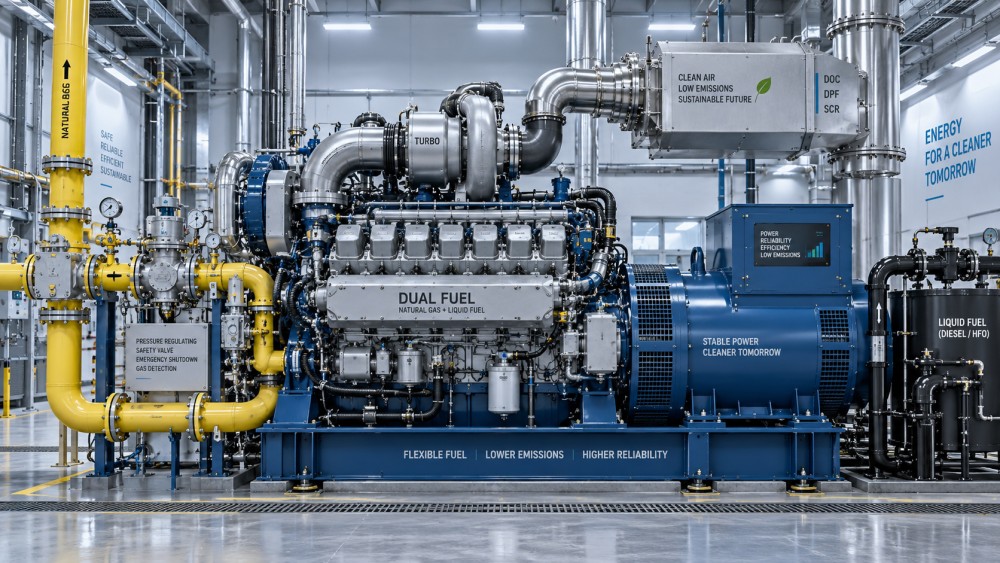
The central judgment is this: dual-fuel industrial engines should be evaluated as controlled combustion systems, not as single-fuel engines with an added fuel line. Fuel flexibility has value only within defined limits for fuel quality, load, ambient conditions, transient duty, and emissions control. Before comparing ratings, technical evaluators should establish how the engine switches fuels, which operating points require derating, what emissions are measured in each mode, and how the control system handles instability rather than merely detecting it.
Start with the combustion concept, because “dual fuel” covers different behavior
Most dual-fuel industrial engines use one of two broad approaches. In a low-pressure, premixed arrangement, gaseous fuel is mixed with intake air and a small quantity of liquid pilot fuel initiates ignition near top dead center. In a high-pressure gas-injection arrangement, gas is injected later in the compression cycle, generally closer to the liquid-fuel combustion event. The hardware, safety architecture, emissions profile, and switching behavior differ substantially.
Premixed operation can reduce certain local high-temperature combustion zones, which can support lower nitrogen oxide formation under appropriate conditions. However, it is more exposed to combustion variability at low load, load-step limitations, methane slip where methane is the fuel, and knock risk when gas reactivity or charge conditions change. High-pressure injection can preserve diesel-like combustion characteristics and load response more closely, but it introduces a different fuel supply and injection system complexity.
Some installations also describe an engine as dual fuel when it runs fully on liquid fuel in one mode and fully on gas in another, without pilot-assisted gas operation. That distinction matters. A true pilot-ignited engine may transfer fuel share gradually while maintaining firing stability. A system that requires a shutdown, purge, or substantial load reduction before changing modes has a different availability profile.
Ask for the operating map, not only the headline fuel capability. The map should identify permitted fuel modes, pilot-fuel ranges, maximum gas substitution rate, stable minimum load, transient restrictions, and any excluded combinations of ambient temperature, inlet-air condition, and fuel composition.
Fuel switching is a control event, not a valve action
During changeover, the engine management system must balance energy input while maintaining an acceptable air-fuel ratio and combustion phasing. Gas and liquid fuels do not have the same density, heating value, ignition delay, flame speed, or volumetric displacement in the intake charge. Replacing liquid energy with gas energy therefore affects more than fuel flow.
A well-managed transition normally coordinates several actions: gas admission is ramped, liquid injection is reduced or retained at a minimum pilot level, boost pressure and air handling are monitored, and cylinder-specific combustion indicators are checked where available. The controller may limit the rate of fuel substitution until exhaust temperatures, peak cylinder pressure proxies, or knock indicators settle within permitted bands.
Problems often show up first during a load ramp rather than at steady state. An engine can be stable at a fixed intermediate load but struggle when a large motor starts, a grid event occurs, or a process demand rises sharply. The gas train and pressure regulator may not respond at the same rate as the engine’s torque demand. Meanwhile, the turbocharger may not yet provide enough air to maintain the intended excess-air ratio. The controller may temporarily increase pilot quantity, reduce gas fraction, delay the load acceptance, or revert to liquid fuel.
None of those actions is automatically a defect. The practical question is whether the behavior is defined, repeatable, and compatible with the duty cycle. A standby generator that must accept a large block load has different switching priorities from a continuous-duty unit operating against a relatively smooth plant load.
Questions that expose hidden switching limitations
- Can the engine change from liquid to gas while loaded, and within what load range?
- Is the reverse transfer automatic if gas pressure, gas quality, or combustion stability falls outside limits?
- What happens to available power during the transition: is load held, limited, shed, or transferred to another source?
- How much pilot fuel remains at nominal gas operation, and does that fraction rise at low load or during transients?
- Are changeovers permitted while parallel to a grid, operating in island mode, or serving critical step loads?
- Which alarms trigger a controlled return to liquid fuel, and which trigger an immediate trip?
The answers should come from a mode-specific operating philosophy and control narrative, not from a broad statement that the engine “supports seamless switching.” Seamlessness depends on the load profile and the quality of the upstream gas system as much as on the engine itself.
Why emissions cannot be judged from one operating point
Dual-fuel emissions change with combustion mode, gas fraction, load, air-path settings, pilot quantity, and aftertreatment temperature. A compliance claim based on a rated-load test point may not describe the emissions behavior of an engine that spends long periods at part load, cycles frequently, or repeatedly transfers between fuels.
Nitrogen oxides (NOx) are strongly connected to combustion temperature, oxygen availability, and timing. Lean premixed gas operation may reduce NOx in some applications, but the result depends on how lean the engine can operate without unstable combustion. Raising pilot-fuel quantity, advancing combustion, or enriching the mixture to regain response can move NOx in the other direction. Liquid-only fallback mode may have its own NOx profile and may require separate calibration or aftertreatment performance confirmation.
Methane slip is particularly relevant when natural gas is the primary fuel. Unburned methane can leave the cylinder through crevice volumes, incomplete oxidation, valve overlap effects, or incomplete combustion during low-load operation and transients. It is not captured by a simple assumption that gas operation is always lower-impact operation. Oxidation catalysts may assist under suitable exhaust-temperature conditions, but conversion performance can fall when exhaust temperature is low or when the catalyst is not within its effective range.
Carbon monoxide and unburned hydrocarbons tend to reveal incomplete combustion. Their increase may indicate an overly lean or poorly mixed charge, low combustion temperature, inadequate ignition energy, or a load condition outside the preferred gas-mode range. They can also rise briefly during a carefully managed changeover; evaluators should distinguish a short transient excursion from a sustained operating condition.
Carbon dioxide should be assessed on a fuel-and-duty basis rather than by fuel label. The carbon intensity of the fuel supply, the pilot-fuel contribution, electrical efficiency at actual load, and periods of liquid fallback all affect the result. For projects subject to formal emissions limits, the required test cycle, averaging method, correction factors, and applicable jurisdictional rules need to be confirmed before selecting an engine configuration.
Derating is usually a protection boundary, not lost capability by accident
Derating is often misunderstood as a conservative commercial rating. In dual-fuel industrial engines, it is frequently the necessary result of combustion, thermal, and air-handling limits. The available output on gas may be lower than the liquid-fuel rating, and the gap can widen under unfavorable site conditions.
One reason is volumetric displacement. When gaseous fuel enters through the intake path, it occupies volume that would otherwise contain air. Less oxygen mass can be available in the cylinder, especially where intake temperature is high or turbocharger margin is limited. The engine may then need to reduce fuel energy, lower gas substitution, or both to protect exhaust temperature and smoke limits in backup liquid operation.
Knock margin is another major constraint. Methane number or equivalent fuel knock resistance, gas temperature, gas pressure, charge-air temperature, compression ratio, ignition timing, and cylinder deposits can all influence the point at which abnormal combustion becomes unacceptable. A fuel that falls within a broad supply specification may still require a lower permitted load than a more consistent fuel stream.
High ambient temperature and elevation add further pressure. Hot air is less dense; altitude reduces available oxygen mass and compressor operating margin. Cooling circuits also reject heat less effectively under demanding ambient conditions. The engine control system may therefore limit power to preserve turbine inlet temperature, exhaust valve temperature, peak firing pressure, or knock margin. The relevant rating is not the nameplate value alone but the available output at the site’s expected ambient envelope.
Separate the three ratings during technical review
A useful comparison distinguishes mechanical maximum capability, fuel-mode capability, and site-available capability. The first is tied to the engine hardware. The second accounts for whether the engine is running on gas, liquid, or a specified blend. The third includes ambient conditions, fuel quality, auxiliaries, emissions equipment, and duty-cycle constraints. Confusing these ratings can leave an installation unable to meet its required electrical or shaft-power duty during the very conditions when reserve margin is needed most.
Derating should also be considered dynamically. An engine may retain a stated steady-state gas rating but temporarily reduce gas fraction during a rapid load increase. That may preserve delivered power if sufficient liquid pilot or backup fuel is available. In another design, the controller may cap load acceptance to remain within its gas-mode boundary. Both approaches can be appropriate, but they create different fuel storage, emissions, and operational planning requirements.
A practical evaluation sequence before specifying the asset
Begin with the actual duty profile rather than the preferred fuel. Plot the expected load distribution, minimum load periods, ramp rates, largest step load, annual operating hours, islanded versus grid-parallel operation, and allowable interruption or transfer time. This prevents a common mismatch: selecting an engine optimized for high gas substitution at steady load when the application is dominated by low-load running and abrupt demand changes.
- Define the fuel envelope. Document composition, lower heating value range, supply pressure, temperature, contaminants, moisture management, and expected variation. For nonstandard gases, determine whether the engine supplier accepts the fuel without restricting power, maintenance intervals, or emissions performance.
- Build a mode-by-mode power table. Show output in liquid mode, gas mode, transition mode, and degraded gas-quality conditions. Include the applicable ambient conditions and the auxiliary loads deducted from gross output.
- Review control actions at the boundary. Identify the sequence for low gas pressure, gas-trip events, misfire, knock, high exhaust temperature, and loss of cylinder balance. A safe fallback path is as important as normal gas operation.
- Match emissions evidence to operating reality. Request results or compliance documentation that correspond to the intended fuel, rating, duty cycle, and aftertreatment configuration. Do not assume liquid-mode evidence automatically applies to gas mode, or the reverse.
- Examine maintenance implications. Gas admission components, pilot injectors, ignition equipment where fitted, knock sensors, gas valves, and ventilation arrangements introduce inspection and functional-test requirements. The maintenance plan should cover both fuel systems, including the liquid system that may operate only during fallback.
For hydrogen-containing gases, ammonia-derived fuels, biogas, refinery gas, or other nonstandard streams, the fuel review becomes more stringent. Flame speed, ignition characteristics, contaminant exposure, corrosion risk, lubricating-oil impact, and gas detection requirements may differ materially from conventional natural-gas service. A statement that an engine is “fuel-flexible” is not enough to establish suitability for a specific blend or fuel pathway.
Where assessments most often go wrong
The first mistake is treating maximum gas fraction as the same thing as guaranteed gas fraction across the operating range. A high substitution percentage at a favorable steady-state point may decline during cold starts, low-load operation, step loading, poor gas quality, or elevated ambient conditions. Fuel-consumption and emissions estimates should use the expected operating distribution, not the best reported point.
The second is evaluating emissions without the control strategy. A calibration that protects against knock by increasing pilot fuel may still maintain output, but it changes liquid consumption and can alter emissions. Similarly, a controller that rapidly falls back to liquid fuel may protect continuity of power while changing the plant’s emissions basis. These are not peripheral details; they determine whether the installation can meet its technical and compliance objectives under abnormal but foreseeable conditions.
The third is overlooking the upstream system. Gas pressure stability, filtration, double-block-and-bleed arrangements where required, ventilation, hazardous-area classification, purge logic, and emergency isolation can govern availability just as strongly as the engine. An engine cannot compensate indefinitely for a supply system that delivers pressure oscillation, condensate, or composition changes outside its approved envelope.
Dual-fuel operation is most credible when the engine rating, fuel specification, controls narrative, gas-system design, and emissions evidence describe the same operating envelope. When those documents point to different assumptions, the apparent flexibility of the asset may disappear at the load point that matters.
Recommended News