
Industry News
Curation by industry experts
Hot Articles
Popular Tags
Are Dual-Fuel Marine Engines Proven for Ammonia Operation?
Are Dual-Fuel Marine Engines Proven for Ammonia Operation?
Dual-fuel marine engines have demonstrated ammonia combustion, and manufacturers have moved beyond laboratory concepts toward commercial engine offerings. That does not make every ammonia-capable engine a fleet-proven propulsion system. The useful answer is narrower: combustion feasibility is established for specific designs, while reliability must be demonstrated for the engine configuration, fuel system, operating profile, and maintenance regime being purchased.
For a vessel spending long periods at steady ocean-going load, the evidence required will differ from that for a ship frequently maneuvering, changing load, or operating near populated terminals. A successful full-load test answers one question. It does not establish how the installation behaves after repeated fuel changeovers, an injector fault, or a ventilation shutdown.
What are the main risks of ammonia fuel for large engines? Toxic exposure, difficult ignition, unburned ammonia, NOx and potential nitrous oxide emissions, and material compatibility are central concerns. The purchasing mistake is treating these as separate accessories to an otherwise familiar dual-fuel engine. They affect the architecture and operation of the entire propulsion installation.
“Dual-fuel” describes capability, not operating maturity
An LNG dual-fuel engine is not automatically suitable for ammonia. Its gas admission system, combustion strategy, seals, ventilation arrangements, and exhaust treatment were developed for a different fuel. Even where an engine platform supports conversion, the conversion scope needs to be defined rather than inferred from the platform name.
The same caution applies to “ammonia-ready.” Depending on the specification, readiness may mean reserved tank space, structural allowances, a conversion concept, or installed equipment. It does not necessarily mean the vessel can bunker ammonia and operate on it without substantial modification.
There is genuine commercial progress. Wärtsilä announced an ammonia-fuelled Wärtsilä 25 engine solution in 2023, providing a concrete example of manufacturers moving toward commercial supply. However, an announcement or product release is not equivalent to independently documented, long-duration fleet performance. Buyers should request evidence for the offered version, including any subsequent design changes.
Three evidence levels deserve separate treatment: controlled engine testing, integrated shipboard operation, and sustained service across representative voyages. None is worthless. They simply answer different questions. Class approval also matters, but it should not be read as a guarantee of maintenance intervals, fuel cost, or dispatch reliability.
Compared with LNG or diesel, the combustion window needs closer attention
Ammonia is harder to ignite and has slower flame propagation than conventional hydrocarbon fuels under comparable conditions. Ammonia dual-fuel designs generally use a pilot fuel or another ignition-support strategy. The practical question is not simply whether combustion starts, but whether it remains stable throughout the vessel’s required load range.
At steady service load, injection timing, temperature, and air management can be optimized. During harbor approach, the engine may encounter repeated load reductions, short acceleration demands, and fuel-mode changes. Those conditions can expose combustion instability or increased ammonia slip that a favorable steady-state test does not reveal.
Ask for a load map showing ammonia contribution, pilot-fuel consumption, efficiency, and emissions together. The fuel-share definition matters: a mass percentage is not interchangeable with an energy percentage. A headline ammonia substitution figure without its operating point and measurement basis offers little help in estimating voyage performance.
Two-stroke low-speed propulsion engines and four-stroke medium-speed engines also require separate assessment. Injection arrangements, combustion conditions, and duty cycles differ. Evidence from one architecture cannot automatically establish another’s durability. For generator engines, sudden electrical load acceptance may be as important as steady propulsion performance.
Diesel fallback can reduce operational exposure, provided the changeover is demonstrated under credible fault conditions. It is not a complete safety argument. An isolated ammonia circuit can still contain fuel that must be depressurized, purged, or otherwise managed safely.
Toxicity shifts the assessment from the cylinder to the ship
Ammonia’s toxicity makes leakage a different operational problem from a conventional fuel spill. Detection, containment, ventilation, isolation, and safe access need to work together. Ammonia’s strong odor is not an acceptable substitute for engineered gas detection or a defined emergency response.
Consider an injector connection requiring attention after shutdown. Before opening it, the crew needs a verified isolation and purge procedure, a safe destination for residual ammonia, suitable protective equipment, and confirmation that the work area is safe. A maintenance task that is routine on a diesel installation may require a more restrictive permit and preparation process.
Double-walled piping, ventilated enclosures, fuel preparation spaces, and automatic shutdown arrangements may form part of the design, depending on the installation and applicable requirements. Their presence on a drawing is only the starting point. The important questions concern detector placement, ventilation failure, common-cause power loss, and whether isolation leaves trapped liquid in vulnerable sections.
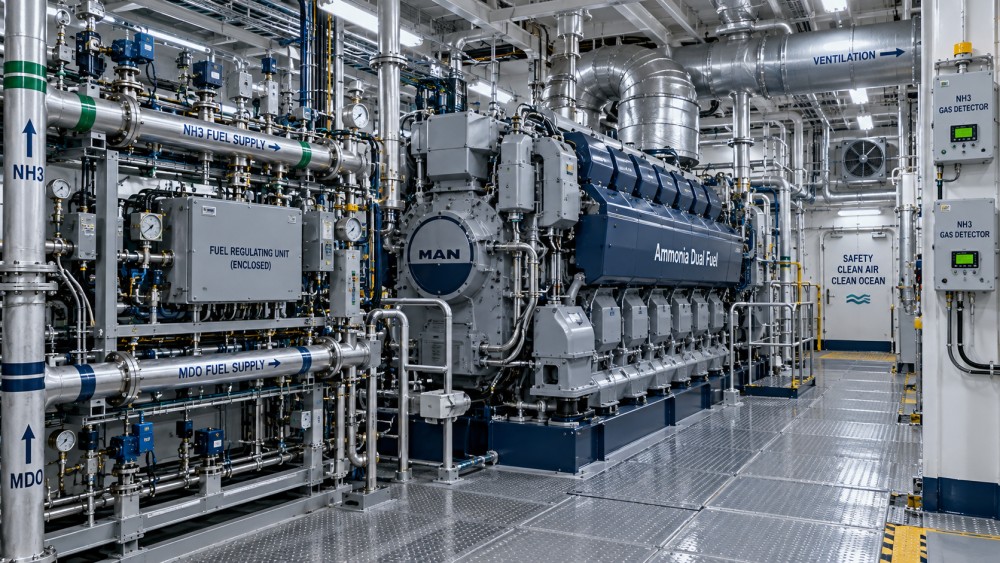
A useful system schematic should trace ammonia from the bunker connection through storage, conditioning, engine supply, purge arrangements, and release-handling equipment. It should also identify ventilation outlets and their relationship to accommodation air intakes. This often reveals integration issues that an engine datasheet cannot show.
Bunkering adds the terminal interface. Emergency shutdown coordination, hose disconnection, exclusion arrangements, and responsibility for leak response must be agreed with the actual supplier and port. A technically capable vessel is not operationally ready if those interfaces remain unresolved.
Carbon-free fuel does not mean emission-free exhaust
Ammonia contains no carbon, so the ammonia portion of combustion does not directly produce CO2. Pilot fuel still can, and upstream ammonia production has its own emissions footprint. A credible climate assessment therefore separates onboard emissions from lifecycle fuel emissions.
The exhaust assessment needs to distinguish three issues. NOx concerns regulated air pollution. Ammonia slip concerns unburned fuel and toxic exposure. Nitrous oxide, or N2O, concerns greenhouse-gas performance. These are different substances with different consequences; a low result for one does not establish control of the others.
Combustion calibration and aftertreatment must be evaluated together. Selective catalytic reduction can control NOx, but its performance depends on temperature and operating conditions. Ammonia slip treatment may also be needed. Depending on catalyst chemistry and conditions, unwanted by-products, including N2O, require attention rather than assumption.
Request engine-out and downstream measurements across representative loads, including transitions where available. Ask how aged catalysts, sensor faults, and low-temperature operation affect results. A clean exhaust measurement with fresh equipment at a favorable load is useful evidence, but it is not a lifetime emissions guarantee.
IMO NOx requirements under MARPOL Annex VI remain relevant where applicable. Fuel safety follows a separate approval path involving flag administration and class, informed by IMO’s interim guidelines for ships using ammonia as fuel. Neither framework should be treated as proof that every commercial or climate-performance claim has been verified.
Storage and materials can change the vessel economics
Compared with marine diesel, ammonia carries less energy per unit mass and generally needs more storage volume for the same delivered energy. The actual vessel penalty depends on tank conditions, containment design, usable capacity, and propulsion efficiency. Additional safety spaces and fuel-conditioning equipment can further affect cargo capacity and machinery layout.
This makes conversion assessment particularly sensitive. Finding room for a tank is not the same as finding room for the complete installation, maintenance access, segregation, and vent routing. A newbuild can accommodate these requirements earlier; a retrofit may involve compromises that outweigh the apparent benefit of retaining the existing engine.
Material compatibility needs component-level review. Copper-containing alloys and some elastomers are unsuitable for ammonia service, while certain steels can face stress-corrosion concerns under particular conditions. Avoid blanket statements that a familiar metal is universally safe. Suitability depends on the grade, stresses, temperature, fuel condition, and manufacturing details.
Fuel specifications belong in this review. Water, oil, and other contaminants may affect equipment or combustion, so purchase specifications should align with the engine and fuel-system supplier’s limits. Those limits must also be practical for the intended bunkering chain.
What evidence should support a purchase decision?
For technical benchmarking, the Global Power-Plant & Engine-Tech (G-PPE) approach is to compare the complete power asset against its operating duty and applicable requirements, rather than rank engines by a single headline specification. For ammonia propulsion, that means bringing combustion data, safety design, emissions performance, and maintenance obligations into the same assessment.
The most useful procurement evidence is specific:
- Representative endurance: operating hours by load and fuel mode, supported by inspection findings rather than accumulated hours alone.
- Transient behavior: demonstrated starting, load changes, fuel switching, and recovery from relevant faults.
- Maintenance exposure: injector and seal condition, wear findings, purge requirements, and realistic component replacement procedures.
- Integrated guarantees: defined fuel quality, ambient conditions, pilot consumption, emissions boundaries, and responsibility across suppliers.
- Service readiness: trained support personnel, spare-parts availability, crew preparation, and clear arrangements for early-service modifications.
An early adopter may reasonably accept a shorter service history if the route, fallback capability, support agreement, and commercial terms contain the risk. A ship whose earnings depend on uninterrupted operation with limited specialist support may require stronger evidence. Neither decision should rest on the word “proven” without qualification.
Before committing, ask the supplier to connect every major claim to a test report, approval scope, inspection record, or contractual guarantee. Where evidence stops at the test bed, price and plan the remaining uncertainty as an integration and operating risk—not as a problem already solved by dual-fuel capability.
Recommended News