
Industry News
Curation by industry experts
Hot Articles
Popular Tags
Sustainable Engine Manufacturing Alerts: Compliance Risks to Watch in 2026
Sustainable Engine Manufacturing Alerts: Compliance Risks to Watch in 2026
As 2026 approaches, sustainable engine manufacturing alerts are becoming essential for quality control and safety managers facing tighter emissions rules, material traceability demands, and cross-border compliance checks. This article highlights the key risks that can disrupt audits, delay certifications, and expose engine programs to costly regulatory setbacks across complex industrial supply chains.
Why sustainable engine manufacturing alerts matter now
Engine programs are no longer judged only by output and durability. They must also prove carbon performance, supplier transparency, and documentation integrity. In heavy-duty reciprocating engines, industrial turbines, and hybrid power systems, sustainable engine manufacturing alerts help teams spot weak links before they become audit findings.
The compliance burden is rising because authorities and buyers increasingly compare declared specifications with real production evidence. If the traceability chain breaks, even a technically sound engine can be flagged as non-conforming. That is why alerts should be treated as a routine operational control, not a late-stage legal review.
Core checks to include in every review
Use the following sustainable engine manufacturing alerts as a baseline for internal inspection and supplier validation.
- Verify emissions test methods, calibration records, and test-bench alignment with the target market standard before any declaration is issued.
- Confirm raw-material traceability for critical castings, alloys, seals, and electronic controls, including batch records and approved substitutions.
- Check whether hydrogen, ammonia, or dual-fuel claims are backed by validated operating envelopes and safety documentation.
- Review supplier ESG and labor disclosures for gaps that could trigger procurement blocklists, delayed approvals, or reputational exposure.
- Compare product labels, technical files, and export paperwork to ensure model numbers, emissions tiers, and efficiency values match exactly.
 Key compliance risks by application
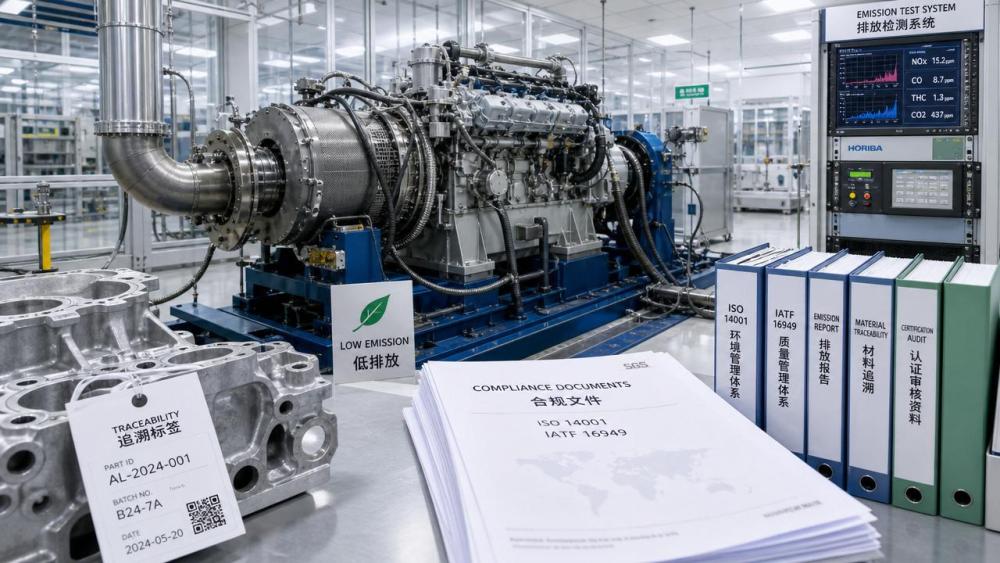 Key compliance risks by application
In data center backup power and utility-scale UPS systems, the main issue is proving low-emission performance without sacrificing uptime. Sustainable engine manufacturing alerts should focus on fuel switching behavior, transient response, and local permitting rules.
For maritime and remote industrial fleets, cross-border compliance is often the bigger risk. Certification files may need to satisfy IMO-linked expectations, port authority reviews, and national reporting rules at the same time. A single mismatch in traceability can delay deployment.
What is often overlooked
One common blind spot is software-controlled compliance. Engine controls, digital twins, and AI uptime systems can alter operating behavior after certification. If firmware updates are not tracked, sustainable engine manufacturing alerts may reveal a hidden deviation from the approved configuration.
Another frequent issue is subcontracted machining and assembly. Even when the final integrator is compliant, undocumented process changes at tier-2 or tier-3 suppliers can invalidate material declarations, weld records, or environmental claims. These gaps are difficult to fix after shipment.
Practical execution steps
Build a single compliance register that links design revision, supplier evidence, test results, and shipping documents. Then assign each sustainable engine manufacturing alert to one owner, one deadline, and one proof source.
Run quarterly document audits before external reviews begin. This timing catches inconsistencies early and reduces the cost of rework. For high-risk programs, require a pre-release gate for any fuel-system, control-system, or material substitution change.
FAQ: sustainable engine manufacturing alerts
Q1: Are sustainable engine manufacturing alerts only about emissions?
No. They also cover traceability, documentation accuracy, fuel compatibility, and supplier conduct.
Q2: Which records matter most?
Test certificates, batch traceability, calibration logs, material declarations, and revision-controlled technical files.
Q3: How can teams reduce audit friction?
Standardize evidence formats, verify data before submission, and keep one approved source of truth for each engine model.
Conclusion and next action
In 2026, sustainable engine manufacturing alerts will separate resilient programs from avoidable compliance failures. The safest approach is to treat each alert as an operational checkpoint, not a paperwork afterthought.
Start with a cross-functional review of emissions proof, traceability data, and change-control discipline. Then close the highest-risk gaps before the next certification cycle, export shipment, or customer audit.
Recommended News