
Industry News
Curation by industry experts
Hot Articles
Popular Tags
How Can You Reduce Battery Storage Fire Risks at a Data Center?
How do I avoid battery storage fire risks at a data center? For engineering leaders responsible for critical uptime, the answer starts with layered protection—not a single safety device. Battery chemistry, installation layout, thermal management, fault detection, and emergency response must work together. A battery management system cannot compensate for poor separation, and a fire suppression system cannot make an unsuitable battery installation safe.
The difficult decisions usually arise before anything goes wrong: whether to replace lead-acid UPS batteries with lithium-ion, place batteries near electrical rooms, or add a larger energy storage system for peak shaving and grid support. Each choice changes the risk profile. The objective is not simply to prevent ignition; it is also to limit propagation, protect personnel, and prevent one battery incident from disabling otherwise independent power paths.
Start by separating UPS risk from energy storage risk
A short-duration UPS battery bank and a battery energy storage system supporting extended operation may share a chemistry, but they do not necessarily share the same hazards, operating patterns, or regulatory requirements.
UPS batteries typically support critical loads until generators accept the load or another supply becomes available. A larger energy storage system may cycle frequently, operate at higher sustained power, and contain substantially more stored energy. Some installations combine these functions, making operating controls and fault coordination more complicated.
Do not classify risk by the equipment label alone. Document chemistry, usable and total stored energy, enclosure construction, indoor or outdoor location, ventilation, and proximity to critical infrastructure. Establish the applicable code pathway with the authority having jurisdiction before procurement—not after delivery.
Battery chemistry: compare failure behavior, not just footprint
Space pressure makes lithium-ion attractive in data centers, but “lithium-ion” describes a family of chemistries rather than a uniform safety profile. Likewise, replacing lithium-ion with lead-acid does not eliminate battery hazards.
LFP versus nickel-based lithium-ion
Lithium iron phosphate, or LFP, generally offers greater thermal stability than many nickel-based lithium-ion chemistries. Nickel manganese cobalt, or NMC, can offer higher energy density, which may reduce installation footprint. These are useful distinctions, but neither settles the procurement decision.
LFP systems can still experience thermal runaway, release flammable gases, and create dangerous conditions inside enclosed spaces. Cell quality, manufacturing consistency, electrical protection, module spacing, and enclosure design can outweigh a chemistry advantage in a poorly engineered installation.
Compare complete systems using relevant test evidence. Ask whether the tested configuration matches the offered cells, modules, racks, spacing, ventilation, and protective features. A favorable result for a different enclosure is not automatically transferable.
Lead-acid versus lithium-ion
Lead-acid batteries avoid the same lithium-ion thermal runaway mechanism, but introduce other concerns: hydrogen generation, electrolyte exposure, high fault currents, and substantial floor loading. Valve-regulated lead-acid batteries can also experience thermal runaway under unfavorable charging and temperature conditions.
For an existing facility with suitable ventilation, structural capacity, and established maintenance practices, lead-acid may remain a reasonable choice. For a space-constrained expansion, lithium-ion may be more practical. Compare lifecycle maintenance, failure modes, installation requirements, and incident consequences—not only purchase price or energy density.
Prevent a battery fault from becoming a facility event
The most consequential layout question is often simple: what can one failing battery enclosure damage? A battery room beside both redundant power paths can undermine resilience even when the electrical design appears fully redundant.
Indoor installations offer convenient integration and controlled environmental conditions, but can place smoke, heat, and released gases close to occupied areas and critical equipment. Outdoor installations can reduce some building exposure, yet introduce weather, flooding, temperature extremes, vehicle impact, and access constraints. Neither arrangement is inherently safe without an appropriate design.
- Separate common-mode exposures. Assess whether one incident could affect both A and B power trains, shared controls, generator starting systems, or essential cooling equipment.
- Provide required separation and compartmentation. Determine distances, fire-resistance ratings, and allowable arrangements from adopted codes and applicable test evidence.
- Protect escape and response routes. Keep battery equipment away from locations where an incident could block evacuation or responder access.
- Evaluate environmental threats. Include water intrusion, nearby combustible storage, mechanical damage, and maintenance activities.
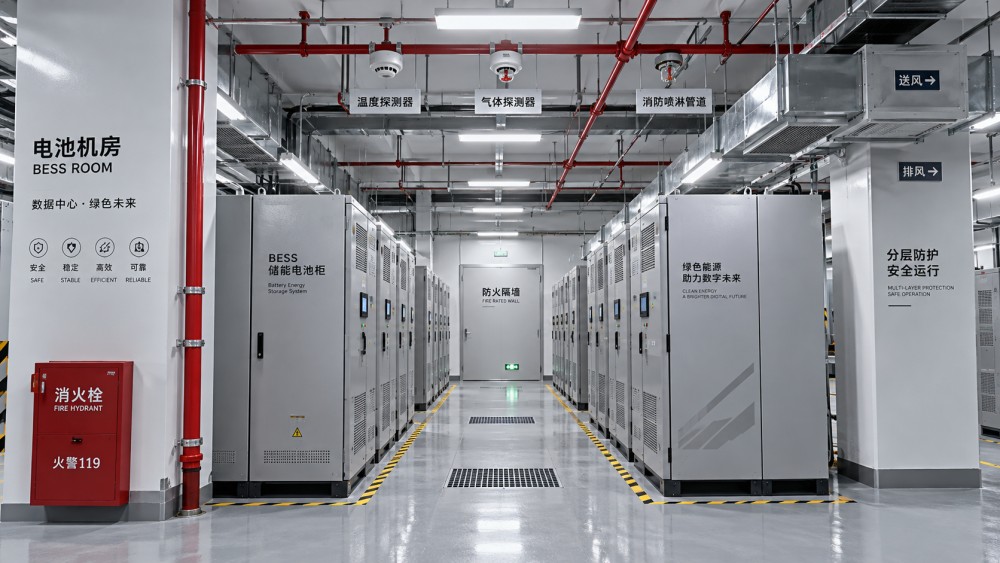
A useful layout drawing shows more than battery footprints. It identifies fire compartments, air pathways, electrical isolation points, gas detection locations, responder approaches, and exposed critical assets. This makes trade-offs visible before construction locks them in.
Detection and controls: what each layer can—and cannot—do
Thermal runaway can develop from internal defects, external heating, overcharge, electrical faults, or physical damage. A layered monitoring strategy improves the chance of recognizing abnormal conditions, but no sensor should be treated as a guarantee of early warning.
Translate detection into a documented cause-and-effect matrix. Define which events trigger an advisory, suspend charging, isolate a rack, initiate evacuation, or notify emergency services. Specify what happens if communications fail or a sensor becomes unavailable.
Where protective functions are required, they should not depend solely on a general-purpose dashboard or AI analytics platform. Analytics can help identify trends, but safety-critical actions need appropriate engineering, dependable interfaces, and testing. Operators also need intelligible alarms: repeated nuisance alerts encourage the very workarounds that weaken protection.
Cooling, suppression, and gas management serve different purposes
Normal thermal management helps prevent overheating by maintaining the operating environment specified by the manufacturer. Review temperature distribution across racks, not just the room thermostat. Blocked airflow, failed fans, abnormal charging, and unnoticed hot spots can create conditions that average temperature readings conceal.
Fire suppression addresses a different problem. Water-based protection can provide cooling and help limit fire spread in many lithium-ion installations, but suitability and design depend on the system, location, test evidence, and applicable requirements. Clean-agent systems may suppress certain surrounding fires without providing enough cooling to stop cell-to-cell thermal runaway.
This distinction matters when comparing proposals. “Includes fire suppression” is not a complete safety argument. Ask what the system is intended to achieve: control a room fire, cool exposed equipment, limit propagation, or protect structural elements.
Released gases create another hazard. Flammable mixtures can accumulate before ignition, particularly inside enclosed equipment or rooms. Ventilation, explosion prevention, and deflagration protection require a coordinated engineering assessment. Ordinary comfort ventilation is not a substitute, and automatically changing airflow during an incident can have unintended effects.
Battery fire planning should also account for contaminated runoff, residual electrical hazards, and possible reignition. These are reasons to involve fire protection specialists and local responders during design rather than relying on a generic emergency procedure.
Use standards as a verification framework, not a badge collection
Relevant requirements depend on jurisdiction, adopted editions, installation size, chemistry, and equipment classification. UPS arrangements may receive different treatment from other energy storage installations, so applicability must be checked rather than assumed.
- NFPA 855 addresses installation of stationary energy storage systems. Check its scope, exceptions, and application alongside local fire and building codes.
- UL 9540 addresses energy storage systems and equipment. Where applicable, evaluate the complete system listing rather than assuming listed components establish system compliance.
- UL 9540A is a test method for evaluating thermal runaway fire propagation. It is not a blanket certification that a system cannot burn.
- UL 1973 covers batteries for specified stationary and motive auxiliary applications. Its scope differs from installation-level requirements.
- NFPA 75, electrical codes, and applicable UPS standards may also inform the protection and integration of information technology and power equipment.
Request the relevant reports and listing details, not just a sales-page statement that equipment is “UL compliant.” Review test scale, observed propagation, gas release, and installation limitations with qualified specialists. Confirm whether changes in cell supplier, firmware, rack construction, or suppression arrangements affect the evidence supporting the proposed configuration.
Procurement questions that expose weak proposals
Engineering and procurement teams need a shared evaluation basis. The cheapest offer can become expensive when required separation, ventilation, structural work, or commissioning is missing from its scope.
For a technical benchmarking platform such as G-PPE, the useful comparison is between complete power architectures—not isolated battery specifications. Battery protection must align with UPS behavior, generator transfer timing, electrical coordination, and the facility’s resilience strategy.
- What was actually tested? Obtain configuration-specific evidence and identify differences from the proposed installation.
- What happens after a single-cell failure? Examine propagation controls, alarms, isolation, and exposure to adjacent equipment.
- How is the system kept within safe limits? Review charging controls, thermal management, protective settings, and degraded-mode behavior.
- Who owns integration? Assign responsibility for fire systems, ventilation, building interfaces, controls, and acceptance testing.
- What happens throughout service life? Confirm inspection requirements, replacement compatibility, firmware management, spare parts, and end-of-life handling.
Require an agreed commissioning plan. It should verify alarm routing, shutdown logic, isolation interfaces, cooling failure responses, and emergency notifications through safe test methods. Any test that could interrupt critical power needs an approved operational plan and suitable safeguards.
Make the emergency plan usable under pressure
When an enclosure begins venting or an alarm escalates, operators should not be debating whether uptime takes priority over evacuation. Establish decision thresholds in advance and coordinate them with responders, the equipment supplier, and facility leadership.
Provide responders with battery chemistry, installation drawings, isolation locations, emergency contacts, and known gas and electrical hazards. Train staff to withdraw from suspected battery incidents and follow the site response plan rather than opening enclosures, attempting improvised firefighting, or resetting protective trips.
Finally, exercise the recovery process. Define how qualified personnel will assess damaged equipment, manage residual energy, monitor for reignition, and authorize re-entry or restoration. Returning power quickly is valuable; returning it without understanding the remaining hazard can turn recovery into a second incident.
Reducing battery storage fire risks at a data center therefore comes down to a disciplined comparison: choose the system whose failure behavior is understood, whose installation limits are respected, and whose protective layers are verified together. The strongest design does more than preserve normal uptime. It gives people a clear, defensible response when normal operation ends.
Recommended News